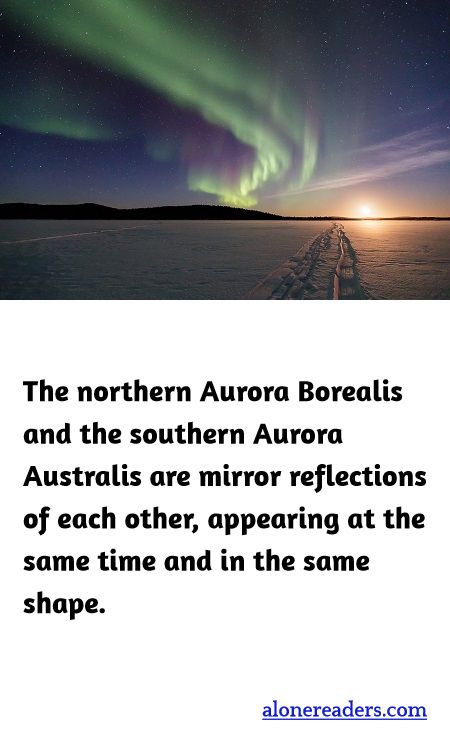
The auroras, both the Aurora Borealis (Northern Lights) and the Aurora Australis (Southern Lights), are stunning natural light displays that occur in the polar regions of the Earth. These lights are essentially caused by the interaction between the Earth's magnetic field and charged particles from the sun. When these particles collide with gases in Earth's atmosphere, they emit light, which creates the beautiful and ethereal displays known as auroras.
Although both the northern and southern auroras are driven by the same fundamental processes, the idea that they are exact mirror reflections of each other in terms of timing, appearance, and shape is a common misconception. In reality, the occurrences of auroras in both hemispheres are closely related and often simultaneous because they are caused by the same solar wind streams interacting with the Earth. However, the patterns and shapes seen in the sky do not mirror each other exactly.
The differences in geomagnetic activity, atmospheric conditions, and the observer's geographic location affect the visibility and appearance of auroras. The ionospheric conditions, such as the density and composition of the atmosphere at different altitudes, can vary significantly between the northern and southern polar regions. These variations can alter the forms and even colors of auroral displays. Additionally, the configuration and orientation of the Earth's magnetic field lines at the poles can result in different visual manifestations of auroras.
Furthermore, auroral activity is also influenced by the intensity of solar activity and its interaction with Earth’s magnetic field. Solar flares, coronal mass ejections, and other explosive events on the Sun can enhance the intensity and frequency of auroral events, but this does not ensure symmetric occurrences in both hemispheres. The dynamics of the solar wind and the complexity of Earth's magnetosphere can lead to distinct differences in how auroras appear at any given time.
In summary, while the Aurora Borealis and the Aurora Australis are produced by the same celestial mechanisms and may occur simultaneously during periods of strong geomagnetic storms, they are not perfect mirror images of each other. Each display is unique and influenced by a variety of interdependent factors that can affect the shape, color, and timing of these breathtaking natural phenomena. The variations contribute to the unique beauty and allure of the auroras, making each occurrence a distinctive spectacle to witness.
