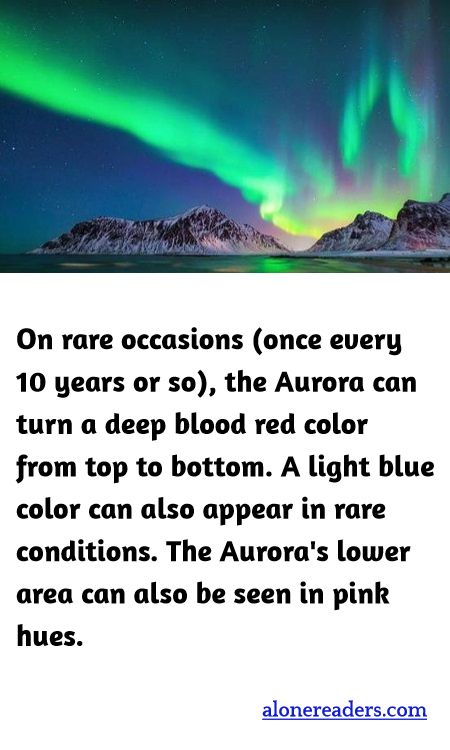
The Aurora, known primarily for its vibrant green waves dancing across the sky, can occasionally transform into an extraordinary spectrum of colors under rare conditions. Among these rare natural displays, the most striking might be when the Aurora turns a deep blood red from top to bottom, an event that happens approximately once every decade. This dramatic color shift occurs when high-altitude oxygen, at heights of around 200 miles above the Earth’s surface, is struck by electrons from the magnetosphere. This interaction results in the emission of red light, distinct from the usual green color which is produced by oxygen at lower altitudes.
Another rare spectacle includes the appearance of light blue in the Aurora. The blue coloration results when nitrogen molecules are excited by the electrons from the Earth's magnetosphere. Although nitrogen can also emit a red light, the ionization process typically results in a blue glow, adding a surreal contrast against the dark night sky. This particular hue is rarer than its green and red counterparts due to the specific atmospheric conditions required for nitrogen to become visible.
In addition to these, the lower area of the Aurora can exhibit pink hues, which manifest when nitrogen and oxygen mix at lower altitudes. This creates a soft pink fringe that can edge the greener curtains of light, providing a delicate boundary that contrasts starkly against the deeper, dramatic reds and the unusual blues.
These variations in color are not merely a spectacle of beauty but also a compelling illustration of our planet's complex magnetic and atmospheric sciences. They serve as practical examples of Earth’s magnetic field interacting with solar winds, and how different particles at various altitudes react to this cosmic dance. Events such as a completely red Aurora are scientifically significant because they often coincide with intense solar storms, which can have profound effects ranging from disrupting satellite communications to affecting electrical grids on earth.
Thus, while inherently beautiful and awe-inspiring, the color variations in the Aurora Borealis also deepen our understanding of the Earth’s relationship with its solar environment. Observing these colors can lend valuable insights into the processes happening far above the planet’s surface, illustrating once again how dynamic and interconnected our universe is.
