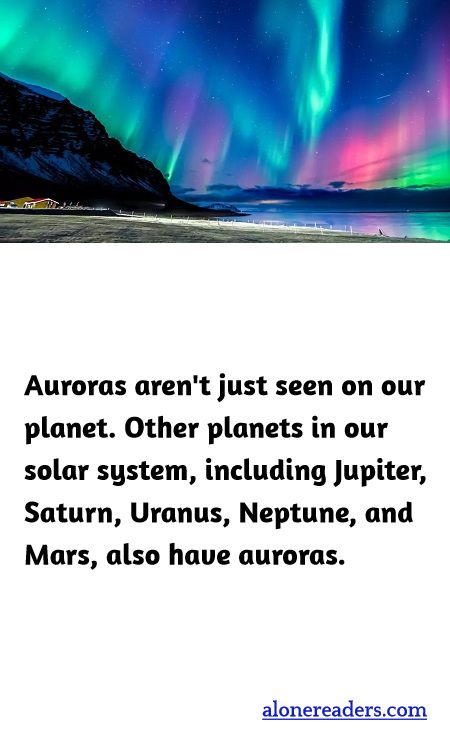
Auroras, the enchanting lights that dance across the polar skies of Earth, are not a phenomenon exclusive to our planet. Various other planets within our solar system also boast these mesmerizing displays, thanks to their magnetic fields and atmospheric compositions.
On Jupiter, the largest planet in our solar system, auroras occur with an intensity far greater than those on Earth. Unlike Earth, where auroras are generally powered by solar winds, Jupiter's immense magnetic field pulls charged particles from its surroundings, including its volcanic moon Io, which spews sulfur dioxide into space. These particles collide with Jupiter’s atmosphere, creating spectacular light shows that are permanent features at both the planet’s poles.
Saturn's auroras are similar to those on Earth and Jupiter, but they are unique due to the planet's complex and layered magnetic field. Interestingly, Saturn’s auroras can last for days, as opposed to the more transient displays on Earth. The interaction between the solar wind and Saturn's magnetic field generates these bright and beautiful spirals of light, often seen in ultraviolet wavelengths.
Uranus and Neptune, both categorized as ice giants, present auroras as well. Despite the infrequency of solar wind effects due to their great distance from the Sun, the magnetic fields of these planets are strong enough to generate significant auroral activities. Uranus’s particularly tilted magnetic field, approximately 60 degrees off from its axis of rotation, contributes to uniquely distributed and irregular auroral displays.
Mars, on the other hand, displays auroras in a different manner. Lacking a global magnetic field, auroras on Mars are not a usual sight but can occur under specific circumstances. The solar wind interacts with residual patches of magnetic fields in the Martian crust, primarily in the southern hemisphere, creating discrete and localized auroras. These are not as intense or as widespread as those on Earth and other gas giants but are nonetheless a significant aspect of Mars’s atmospheric phenomena.
The presence of auroras across different planets highlights the dynamic and varied nature of the atmospheres and magnetic environments in our solar system. These luminous phenomena provide key insights into the magnetic and atmospheric properties of the planets, offering clues about their formation, evolution, and the fundamental processes at work in their environments. Each planet’s auroras tell a unique story about its characteristics, making them a rich subject of study in planetary science and a spectacular reminder of the wonders of our solar system.
