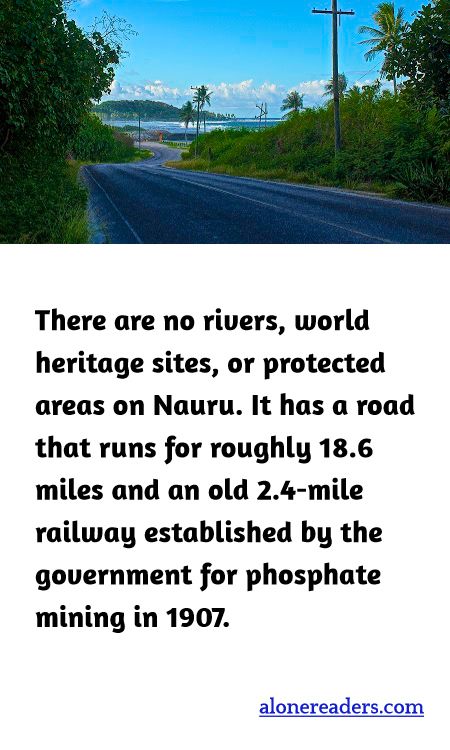
Nauru, one of the smallest island nations in the world, finds itself in a unique environmental and infrastructural situation. Although it lacks natural rivers, World Heritage sites, or formally protected areas, the island holds its own charm and historical gravity, particularly through its past and present economic activities. Historically, Nauru's economy has heavily relied on phosphate mining, an industry that has dramatically shaped both its landscape and its infrastructure.
Established in 1907 by the government, a 2.4-mile railway was built specifically to support the phosphate mining industry. This railway, despite its limited length, was crucial in transporting phosphate from the mines to the processing facilities and, eventually, to the ports for export. Although no longer in use, remnants of this railway stand as a historical artifact, offering insight into the island's economic past and the reliance on phosphate as a pivotal revenue source.
Today, the island is circumscribed by a single road stretching approximately 18.6 miles. This arterial road is vital, serving as the principal thoroughfare for the island’s inhabitants. It facilitates not only the movement of goods and people but also acts as a crucial link connecting the various communities scattered across this small nation.
Despite the absence of formal protected natural areas or sites recognized for outstanding universal value by UNESCO, Nauru possesses a terrestrial uniqueness. The central plateau, where phosphate mining occurred, and the surrounding coral reefs, present significant natural features. These areas, despite bearing the scars of extensive mining, are slowly experiencing natural regeneration, highlighting the resilience of natural ecosystems.
In conclusion, while devoid of conventional natural attractions like rivers, World Heritage sites, or allocated protected zones, Nauru offers a different perspective on human resilience and adaptation. Its infrastructure, though minimal, underscores a history of economic mono-dependence while pointing towards avenues for sustainable development and ecological recovery. As one of the planet's smallest countries, Nauru presents a case study in balancing economic needs with environmental conservation and showcases the potential paths forward for similar small island nations.
