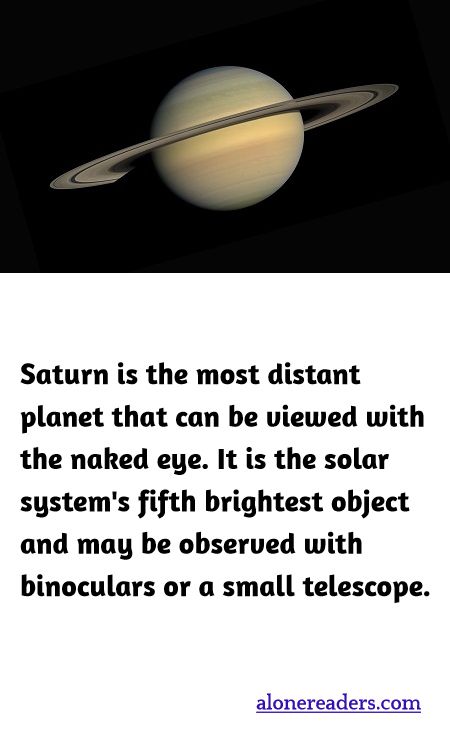
Saturn, the sixth planet from the Sun, holds a special place in the night sky and in the curiosity of astronomers and enthusiasts alike. Known for its stunning rings, which are visible even through a small telescope, Saturn is also the most distant planet that can be seen with the naked eye. Among the celestial bodies, it ranks as the fifth brightest object in the solar system, making it a prominent feature in various cultures and histories of astronomy.
Viewing Saturn through binoculars or a small telescope can be a breathtaking experience. Even basic binoculars can help reveal the shape of Saturn’s rings, though they may appear as a single object attached to the planet. A small telescope, on the other hand, provides a clearer view, distinguishing the gaps and layers within the rings. This makes Saturn a fascinating study object, not only for professional astronomers but also for amateurs and stargazing enthusiasts.
The rings of Saturn, composed of ice and rock, are its most distinctive and fascinating feature. They are thought to be remnants of comets, asteroids, or shattered moons that broke apart before they reached the planet, pulled by Saturn’s immense gravitational force. This debris forms rings due to the balance of gravity pulling them towards Saturn and their orbital speed trying to fling them out into space. The phenomenon of these rings offers important clues about the processes of planetary formation and the dynamics of our solar system.
Moreover, Saturn also has a large number of moons, with Titan being the most notable among them. Titan, larger than the planet Mercury, is of great interest due to its thick atmosphere and the presence of liquid rivers and lakes of ethane and methane. Studying Titan can provide insights into conditions that might be similar to those of early Earth, furthering our understanding of the evolution of habitable environments.
For those interested in observing Saturn, the planet typically shines with a steady, yellow-white glow. It can usually be seen in the night sky at specific times of the year when it is opposite the sun, an event known as opposition. This alignment allows Saturn to appear brighter and closer to Earth, providing the best conditions for viewing its rings and moons.
In conclusion, Saturn is not just another dot in the night sky but a rich and compelling celestial body with distinctive rings and numerous moons. Its visibility to the naked eye and the relative ease with which its basic features can be seen through binoculars or small telescopes make it an accessible and rewarding object for both amateur stargazers and professional astronomers.
