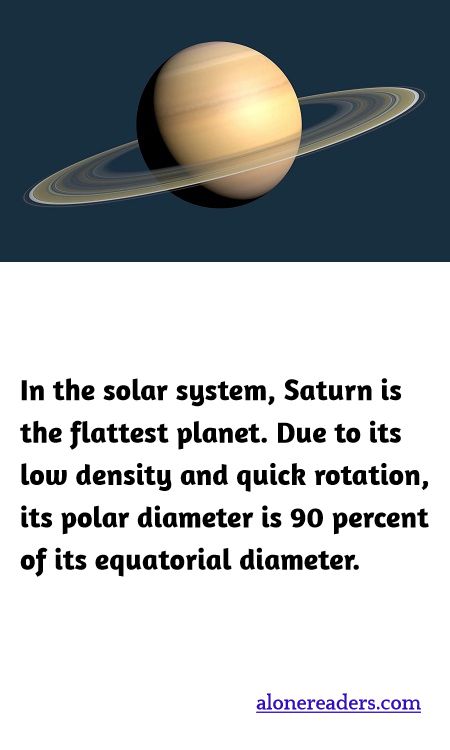
Saturn is renowned not only for its stunning rings but also for being the flattest planet in our solar system. This unique attribute is primarily a consequence of its rapid rotation combined with its relatively low density. Saturn rotates on its axis once approximately every 10.7 hours, which is incredibly fast considering its size—with a diameter of about 120,536 kilometers. This rapid rotation causes the planet to bulge out at the equator while flattening at the poles.
In terms of dimensions, Saturn's polar diameter is about 90 percent of its equatorial diameter. To put it into perspective, the equatorial diameter measures around 120,536 km, whereas the polar diameter stands at approximately 108,728 km. This flattening effect is due to the centrifugal force generated by the planet's quick spin, pushing more mass outward at the equator.
Apart from its distinctive physical shape, Saturn is also interesting because of its composition and density. It is mostly made up of hydrogen, with small amounts of helium and other elements. These gases are in a state that fluctuates between liquid and gas, known as a supercritical fluid, due to the high pressure inside Saturn. With a density less than water, if there were a bathtub large enough to hold it, Saturn would float.
The combination of Saturn's rotation and its gaseous makeup results in the least dense planet in the solar system having a distinct, flattened look, as well as intriguing dynamics in its atmospheric and ring systems. This structure influences everything from wind speeds to the behavior of its iconic rings, which consist of chunks of ice and rock, some as tiny as dust particles and others as large as mountains.
The compelling physical characteristics of Saturn not only make it a subject of beauty and fascination but also an object of scientific research that can provide insights into the nature of other celestial bodies both within our solar system and beyond. Understanding why Saturn is so flat and how its physical properties affect its rings and moons continues to be a key focus for astronomers and planetary scientists.
