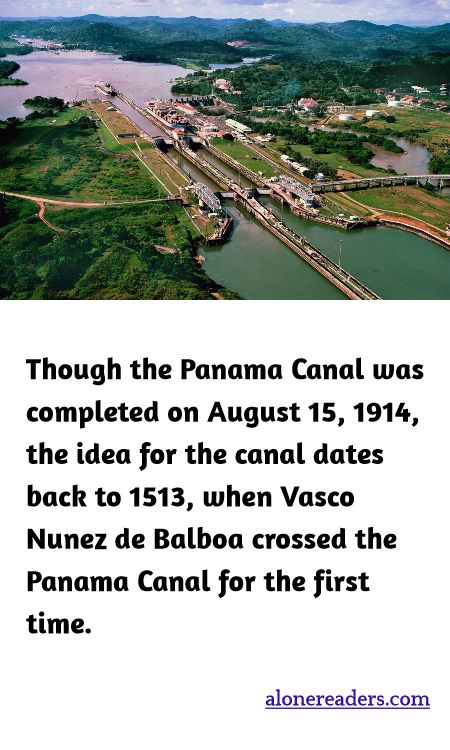
The Panama Canal, an engineering marvel that dramatically changed global maritime trade, was indeed completed on August 15, 1914. However, the concept of creating a waterway across the Isthmus of Panama can be traced back to the early 16th century. The notion was first considered more seriously after Vasco Núñez de Balboa famously crossed the isthmus in 1513 and became the first European to witness the Pacific Ocean from the New World. His discovery ignited the interest of the Spanish Crown in finding a navigational shortcut between the Atlantic and Pacific Oceans, which would significantly ease the perilous and lengthy journey ships had to undertake around the southern tip of South America.
Despite the early interest, the technology and resources required for such a monumental construction were not available at the time. Over the centuries, the idea remained alive, and various proposals and studies were conducted by different entities, including the Spanish and later the French. The most notable attempt before the eventual construction by the United States was led by Ferdinand de Lesseps, the French engineer who had successfully built the Suez Canal. His attempt to construct a sea-level canal in Panama in 1881 ended disastrously due to engineering problems and high mortality due to disease among the workforce.
Following the failure of the French, the United States, under President Theodore Roosevelt, took over the project in 1904. Utilizing the latest advancements in engineering, health, and project management, the U.S. organized a massive construction effort. Key challenges included dealing with the tropical diseases of malaria and yellow fever, which were mitigated through the groundbreaking public health measures introduced by Dr. William Gorgas. The engineering challenges were vast and required the creation of an extensive system of locks and an artificial lake, Lake Gatun, to lift ships over the isthmus. The decision to construct a lock-based canal rather than a sea-level canal simplified some of the engineering hurdles and expedited completion.
The completion of the Panama Canal had profound implications on global trade, allowing ships to save time and money by bypassing the long and hazardous route around Cape Horn. It also cemented the strategic military and economic status of the United States as a global power, with direct influence over one of the most important shipping routes in the world. The canal remains a critical conduit for maritime trade, continually adapting to the changing sizes and demands of modern ships. Its centuries-long history, from Balboa's exploration to its completion in 1914, underscores the human quest for exploration and innovation in overcoming natural barriers.
