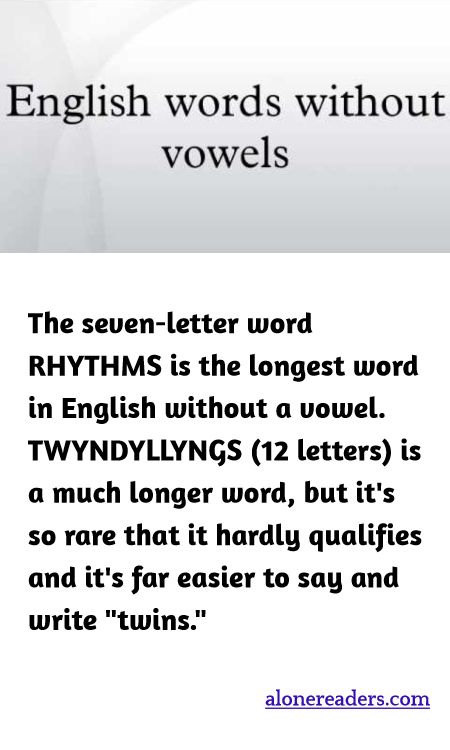
In the vast expanse of the English language, the occurrence of words without vowels is a rarity, especially when such words reach a substantial length. Typically, every English word is inclusive of at least one vowel, whether in its traditional form (a, e, i, o, u) or sometimes y functioning as a vowel. However, there are exceptions that not only break this norm but also add fascinating tidbits to trivia quizzes and discussions for linguistic enthusiasts.
One such word that holds the title for being the longest word without a vowel (in its traditional sense) is "RHYTHMS." Spanning seven letters, RHYTHMS stands out as a unique word where 'y' offers the only semi-vowel sound but its primary role here is more consonantal. It's a term well-used in both everyday language and specialist fields like music and poetry, making it noteworthy not just for its vowel-less nature but also for its utility and familiarity.
On the other end of the spectrum lies "TWYNDYLLYNGS," comprising 12 letters and serving as an old variant of the modern word 'twins.' Despite its length, it’s a lexical rarity seldom employed in either speech or writing due to its archaic nature and complexity. This word underscores how the evolution of language can lead to the simplification of terms over time, making them more accessible and widely used. "Twins," much shorter and straightforward, has become the preferred term, overshadowing its extended counterpart in both usage and recognition.
These words highlight intriguing facets of the English language, showcasing the diversity of its vocabulary and the peculiarities hidden within its extensive lexicon. While "RHYTHMS" holds a record in common usage, "TWYNDYLLYNGS" offers a peek into the historical depths of English, suggesting not just how words evolve over time but also how they occasionally fade into obscurity. Whether used in daily conversation or admired for their linguistic peculiarity, these words without vowels invite curiosity and appreciation for one of the world's most widely spoken languages.
