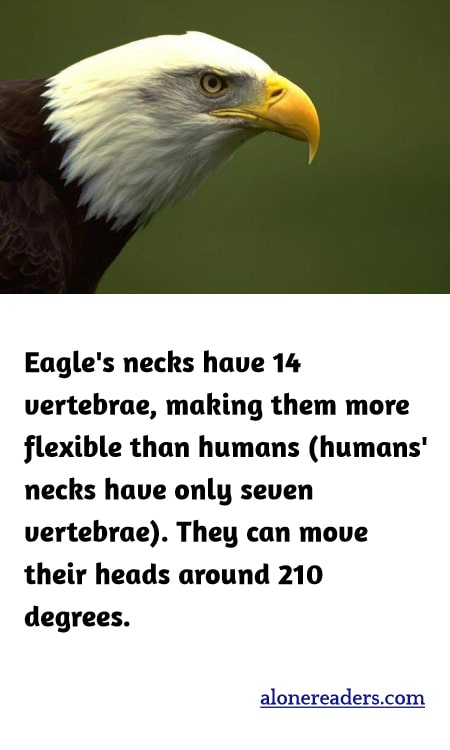
Eagles are renowned for their extraordinary flexibility in their necks, a crucial adaptation that supports their predatory lifestyle. Unlike humans, who have only seven vertebrae in their necks, eagles boast an impressive 14 cervical vertebrae. This anatomical feature significantly enhances their ability to move their heads, granting them the ability to rotate their necks up to 210 degrees. This range of motion is vital for hunting, enabling them to maintain a broad visual field and track prey even in dense foliage or rugged terrain.
The flexibility of an eagle's neck is one of its most remarkable adaptations, allowing for remarkable head movement without the need for the entire body to reposition. This is especially useful for spotting potential food sources from great heights or while perched in static locations. For instance, when an eagle spots a prey animal from a distance, it can observe and calculate the exact moment to strike without the prey ever noticing its predator’s intent.
Moreover, the structure of the neck plays a critical role while eating. Eagles often deal with large preys or carrions, requiring precision and flexibility in maneuvering their heads to rip flesh from their meals. This ability is enhanced by their strong neck muscles, which support the heavier head and beak, crucial for dissecting food efficiently.
In addition to practical hunting and feeding utilities, the extra vertebrae contribute to the majestic posture characteristic of eagles. This graceful control and poise is not just important for physical activities but also plays a role in their social signaling during mating displays, territorial assertions, and other interactions within their species.
Overall, the anatomical design of eagle necks, featuring double the number of vertebrae compared to humans, is a perfect example of evolutionary engineering, tailor-fitting these birds to their ecological niches as dominant aerial predators. This remarkable feature not only facilitates their survival but also underscores the complexity and wonder of avian adaptations.
