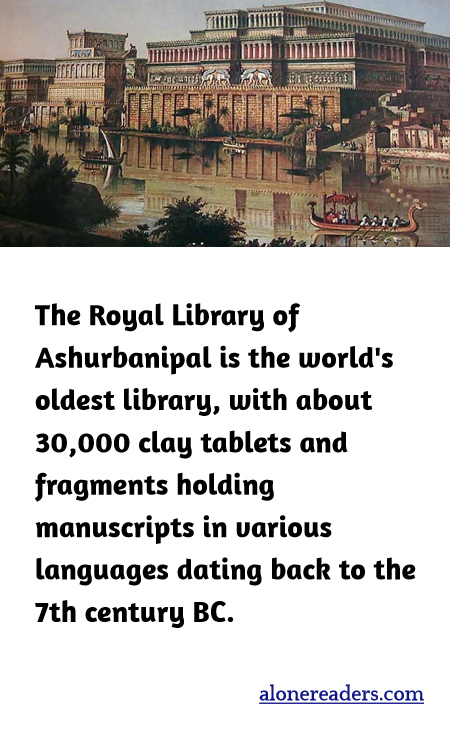
The Royal Library of Ashurbanipal, named after the Assyrian king Ashurbanipal who reigned in the 7th century BC, is renowned as the world's oldest known library. Located in the ancient city of Nineveh, near present-day Mosul in Iraq, this library was a treasure trove of the ancient world. The library predominantly comprises approximately 30,000 clay tablets and fragments, which carry a vast spectrum of texts written in Akkadian and Sumerian languages.
These clay tablets, inscribed with cuneiform script, encompass an extensive range of materials, including literature, religious texts, magical texts, scientific works such as astronomy and medicine, and official documents like treaties and legal decrees. Among the most significant literary works housed in this ancient library is the "Epic of Gilgamesh," a masterpiece of Mesopotamian literature and one of the oldest known epic poems in the world, which offers tremendous insights into early human civilizations and their interactions with the divine and natural worlds.
The establishment of the Royal Library of Ashurbanipal was a testament to the king’s quest for knowledge and his determination to assemble an extensive collection of texts from across his empire. This pursuits not only for intellectual satisfaction but also for political and religious reasons, functioning as a tool to control and unify the vast Assyrian empire through shared knowledge and administrative practices.
The significance of the library extends beyond its role as a repository of texts; it played a crucial part in preserving the cultural and scientific knowledge of Mesopotamia for future generations. The survival of these texts into the modern era has provided scholars with invaluable insights into one of the world’s earliest civilizations. The deciphering of cuneiform script in the 19th century opened up vast areas of ancient Near Eastern history, allowing contemporary audiences to connect with the intellectual achievements of the Assyrians.
Today, the remnants of the Royal Library of Ashurbanipal stand as a symbol of the ancient world's dedication to knowledge and education. Its legacy continues to fascinate historians, archaeologists, and literature enthusiasts, anchoring a crucial period of human history where written records began to shape civilizations profoundly.
