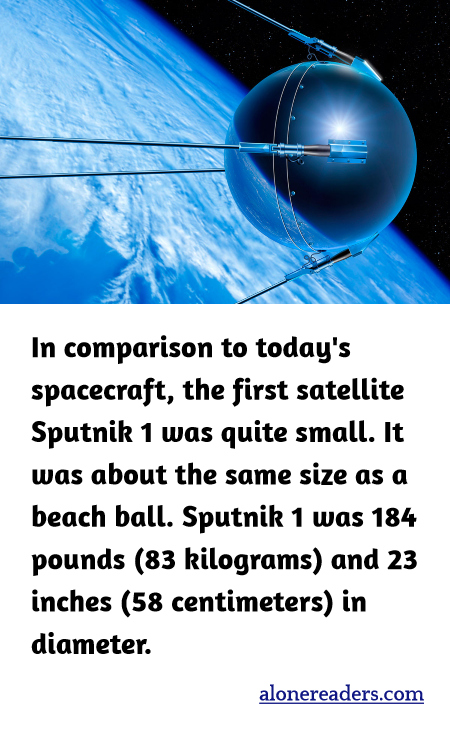
When reflecting on the evolution of spacecraft, it is fascinating to consider the humble beginnings marked by the launch of Sputnik 1. This pioneering satellite, launched by the Soviet Union on October 4, 1957, was modest in size, reminiscent of a beach ball, and weighed just 184 pounds while measuring merely 23 inches in diameter. Today, this might seem minimal given the advanced and expansive technology currently employed in space exploration. Compared to modern spacecraft, Sputnik 1's dimensions and capabilities were significantly limited.
Modern spacecraft are often massive structures equipped with sophisticated technology designed to sustain longer missions, carry more substantial payloads, and conduct complex scientific research. For example, the International Space Station (ISS), one of the most ambitious human-made structures in space, spans about the size of a football field and weighs over 419,725 kg, quite a contrast to the petite Sputnik 1.
Moreover, contemporary satellites and probes possess advanced instrumentation that Sputnik 1 could not have accommodated due to its size and technological limitations at the time. These instruments allow for detailed earth monitoring, deep space exploration, and telecommunications capabilities that have become essential to modern global connectivity and research.
This vivid contrast between Sputnik 1 and today’s spacecraft exemplifies the exponential growth in space technology, driven by decades of research, innovation, and international cooperation. While Sputnik 1 primarily served to signal the advent of space exploration during the Cold War era, it set the stage for the sophisticated pursuits in astronomy, meteorology, and planetary science we witness today, highlighting an incredible journey from a simple spherical satellite to the intricate technologies orbiting our planet now.
