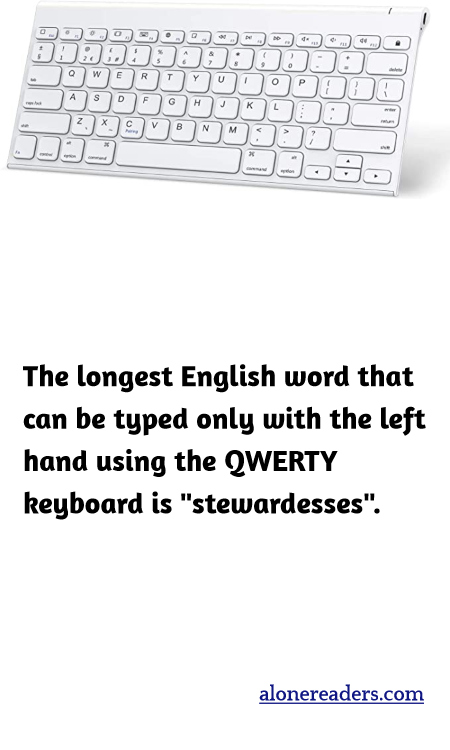
The QWERTY keyboard layout, designed in the 1870s primarily to prevent jamming in typewriters, inadvertently created a unique aspect of typing: keyboard hand bias. Over the years, many keyboard users have experimented with and discussed words that can be typed using only one hand. Among these, "stewardesses" holds a special place as the longest English word that can be typed solely with the left hand.
Interestingly, the ease of typing "stewardesses" with just the left hand is a result of how the QWERTY layout distributes keys between the two hands. The left hand keys include 'q', 'w', 'e', 'r', 't', 'a', 's', 'd', 'f', 'g', 'z', 'x', 'c', 'v', and 'b'. This distribution not only caters to common letter pairings in English but also roughly aims to balance the typing load between both hands. As a result, words like "stewardesses" become fascinating quirks, showcasing a typing convenience stemming from what was originally a mechanical necessity.
This special characteristic contributes to various challenges and activities among typing enthusiasts and those in the fields of ergonomics and keyboard design. It highlights how historical design decisions continue to influence modern technology use. Whether you're a student mastering touch typing or a professional typist aiming to increase your typing efficiency, learning words that favor one hand can be a practical and fun approach to improving your skills. Furthermore, having such words at your fingertips can also spice up typing practice sessions, making them more engaging and rewarding.
Ultimately, the story of "stewardesses" is more than just an oddity of the English language. It serves as a reminder of how history, technology, and human adaptability interlace, creating patterns and possibilities that can continue to interest and benefit us in unexpected ways.
