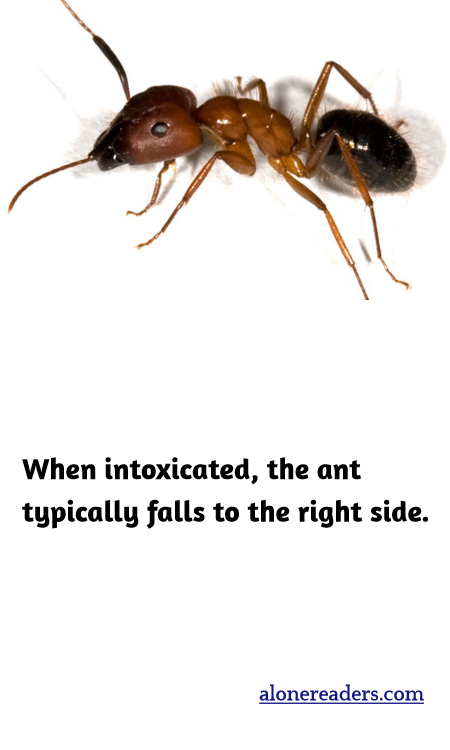
Although it might sound like a curious snippet of trivia, the behavior of drunken ants has intrigued scientists and nature observers alike, highlighting nature’s quirks and the complexities of animal behaviors influenced by intoxicants. The phenomenon where ants predominantly fall on their right side when exposed to alcohol is tied to their neurobiology and the physiology of their locomotion.
Ants, like many other insects, have a highly specialized nervous system that coordinates their movements meticulously. This system allows them to perform the complex tasks necessary for survival, such as foraging, building, and defending their colony. Upon consuming substances like alcohol, typically through fermented organic material in their environment, this coordination is significantly impaired.
The tendency for intoxicated ants to fall to the right has been studied mainly in the context of how neurotoxic substances affect their motor functions. Research indicates that this behavior is likely linked to the dominance of either the left or right hemisphere of the brain in processing spatial orientation and movement. In humans, for instance, the left brain hemisphere, which controls the right side of the body, is often more involved in logical sequencing and motor control. A similar dominance could possibly exist in ants, causing a predilection for falling on one side when their motor faculties are compromised.
Furthermore, the effects of alcohol on ants include disorientation, reduced grip strength on surfaces, and an inability to coordinate their legs effectively. The right-side falling could also be an outcome of the disrupted sensory input to the brain, which is essential for maintaining balance and spatial awareness. Essentially, when an ant's neurological pathways are impaired by alcohol, their system for balance fails them, and the right-side fall occurs as a repeated observable phenomenon.
Insights derived from studying such peculiar behaviors could provide broader implications for understanding how toxins affect smaller organisms, potentially informing ecological assessments of pollution impacts or the development of pest control measures that target neural functioning. Additionally, this line of inquiry deepens our general understanding of insect neurobiology and can even mirror certain aspects of human susceptibility to alcohol and other substances.
In conclusion, the observation that intoxicated ants tend to fall on their right side gives us a fascinating glimpse into the complex interplay of anatomy, brain function, and environmental interactions in even the tiniest creatures. Further research in this area not only satisfies curiosity but also feeds into broader scientific narratives about neurobiology and behavior across species.
