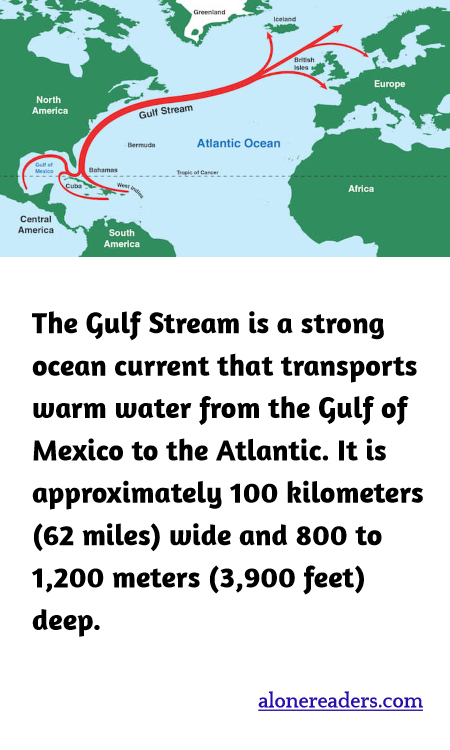
The Gulf Stream, a powerful and warm Atlantic Ocean current, originates in the Gulf of Mexico and flows into the Atlantic at the tip of Florida, accelerating northwards along the eastern coastlines of the United States before crossing the Atlantic Ocean towards Europe. As a crucial component of the global conveyor belt of ocean currents, the Gulf Stream plays a pivotal role in regulating weather and climate patterns not just in North America, but across the Northern Hemisphere.
Spanning approximately 100 kilometers (62 miles) in width and reaching depths of 800 to 1,200 meters (2,600 to 3,900 feet), the Gulf Stream has a significant impact on the climate of the eastern United States and Western Europe. By transferring warm, tropical waters northward, it helps to maintain milder temperatures, especially in Western Europe, which enjoys a more temperate climate than other regions at similar latitudes.
The influence of the Gulf Stream extends beyond just climatic conditions; it also affects marine ecosystems. Its warm currents support a diverse range of marine life and are crucial for the migration patterns of many species. For example, numerous fish species rely on the warm waters of the Gulf Stream to thrive and migrate. Moreover, the current’s path impacts weather systems, playing a part in the formation and the path of hurricanes as they approach the United States.
Moreover, changes in the Gulf Stream can have profound implications for global climate. Scientists monitor the strength and route of the Gulf Stream as part of efforts to understand and predict changes in global climate patterns. There is concern among the scientific community that significant alterations in the Gulf Stream, potentially driven by global warming, could lead to dramatic shifts in weather patterns worldwide. For instance, a slowing or rerouting of the Gulf Stream could lead to cooling in Europe and severe weather conditions in the North Atlantic.
In conclusion, the Gulf Stream is not only a fascinating feature of the Atlantic Ocean but also a vital regulator of weather and climate across two continents. Its effects on marine life, ecosystems, and global climate underscore its importance, making it a subject of continual study in the field of oceanography. As we advance our understanding of how major ocean currents like the Gulf Stream are responding to global environmental changes, it becomes ever more critical to monitor and protect this essential natural resource.
