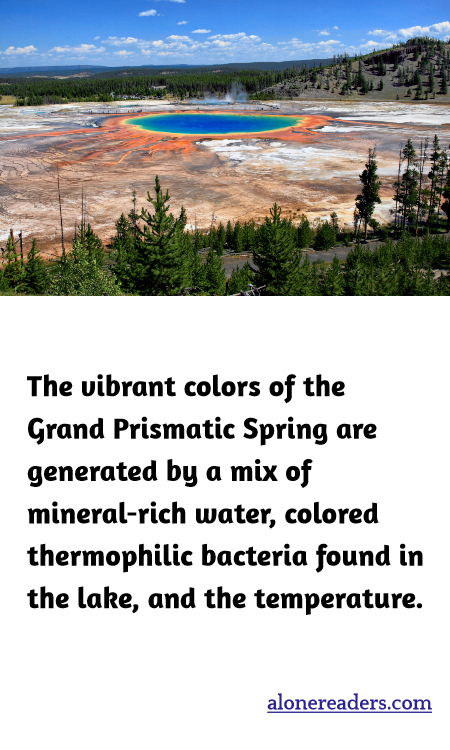
The Grand Prismatic Spring in Yellowstone National Park is not only remarkable for being the largest hot spring in the United States but also for its breathtaking array of colors which radiate outward from blue to green, yellow, and orange. This natural wonder draws its vibrant appearance from a combination of factors involving geothermal activity, mineral-rich water, and bacterial ecosystems.
At the heart of the Grand Prismatic Spring's vivid coloration is its hot, mineral-rich water. As water from deep beneath the Earth's crust rises to the surface in the spring, it brings along various minerals, including silica, which forms the basis of the siliceous sinter deposits that create the spring’s terraced appearance. The high temperature of the water, which can reach up to 189 degrees Fahrenheit, is fundamental in maintaining its stunningly bright blue center. The water’s intense heat ensures that it remains clear of most organisms in the innermost zone, allowing the pure blue color of the water to shine through, a result of the inherent blue of water itself enhanced by the scattering of blue wavelengths by particles in the water.
Surrounding this vivid blue core are rings of vibrant colors ranging from green to yellow, orange, and red. These colors stem from thermophilic (heat-loving) bacteria and archaea that thrive in the slightly cooler temperatures of the outer parts of the spring. These microorganisms form microbial mats, which appear differently depending on the temperature gradient along the edges of the water. For instance, in the slightly cooler parts, cyanobacteria, which can tolerate lower temperatures and still perform photosynthesis, create lush greens and brilliant yellows as a part of their living process.
Each of these unique coloring agents plays an integral role in producing the stunning visual effect seen at Grand Prismatic Spring. Moreover, the variability of the colors can change with the seasons as different bacteria thrive at different temperature levels, which itself can be influenced by the seasonal changes in ambient temperature and sunlight.
Visitors to Grand Prismatic Spring are often mesmerized by its ethereal beauty which is not only a feast for the eyes but also a scientific testament to the complex interactions between geothermal forces and biological life. This natural spectacle demonstrates the delicate balance of a high-energy environment where even slight changes in conditions can lead to dramatic shifts in its appearance, showcasing nature's incredible capacity for adaptation and survival in seemingly inhospitable conditions.
