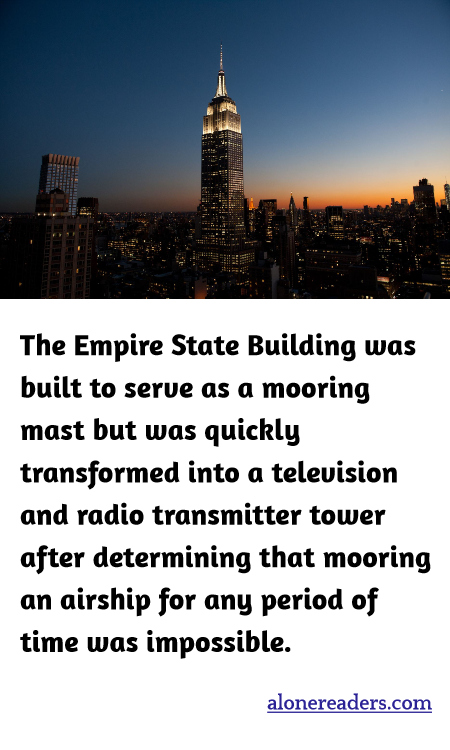
The Empire State Building, an iconic skyscraper located in Midtown Manhattan, New York City, was completed in 1931 during a race to construct the world’s tallest building. Originally, the Empire State Building included a unique feature in its design: a mooring mast intended for airships (dirigibles). This mooring mast was included in the building's spire and was one of the various distinguishing ambitions that characterized the early 20th-century enthusiasm for innovative uses of structures. However, the practical use of the mast for docking airships was quickly found to be impractical and hazardous, primarily due to strong and unpredictable air currents at such a height along with the sizable structures around the skyscraper.
The building's initial idea was to enable passengers to disembark from the airship directly onto the building, thereby creating a novel form of transport hub. Despite its ingenuity, this function was never successfully implemented. After a few attempts, including one by a small commercial airship that tethered itself to the mast but was unable to stabilize sufficiently for safe passenger transfer, it became clear that the concept was not feasible. The anticipated airship industry declined rapidly, and with it, the practicality of airship moorings atop skyscrapers vanished.
Instead of serving its intended purpose, the mast’s role in the Empire State Building took a different turn, marking a transition into a new technological era. The spire was soon put to use as a broadcasting tower. By redefining its function, the Empire State Building became a pivotal broadcast site, particularly for television and radio transmissions. This adaptation proved immensely beneficial, as it enabled the mast to contribute significantly to the building's longstanding role in American cultural and technological advancements.
Thus, what started as an ambitious plan to integrate air travel with urban architecture evolved into a critical piece of broadcasting infrastructure, demonstrating the building’s ability to adapt and find value in unforeseen uses. Today, the Empire State Building's broadcast facilities are integral, supporting major telecommunications for the region and serving as a testament to the dynamic adaptability and enduring legacy of this architectural marvel.
