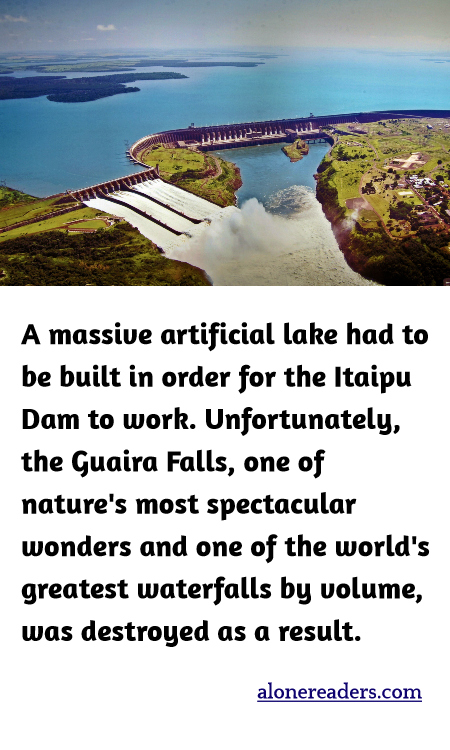
The construction of the Itaipu Dam, one of the world's largest hydroelectric facilities, required a tremendous structural and environmental undertaking, including the creation of a massive artificial lake. This process, while instrumental in generating renewable energy, came with significant ecological and cultural prices. Among the most notable of these costs was the loss of the Guaira Falls, located on the Paraná River between Brazil and Paraguay.
Guaira Falls, once one of the natural world's most breathtaking sights, was indeed a casualty to human progress. Known for being one of the most voluminous waterfalls on the planet, it dwarfed even the famous Niagara Falls in terms of the sheer volume of water that cascaded through its channels. The falls comprised a series of powerful cataracts, with the greatest of these generating sounds that could be heard miles away.
The submersion of the Guaira Falls under the reservoir of the Itaipu Dam ended not only a natural spectacle but also a site of significant historical and cultural importance. Local communities, which had revered the falls for centuries, found their heritage abruptly submerged. Moreover, the ecosystem around the falls, which had been rich in biodiversity, faced profound transformation. Species that once thrived in and around the dynamic waters of the falls either had to adapt to new environmental conditions or perish.
While the Itaipu Dam has been celebrated for its substantial contribution to sustainable energy—providing about 10-15% of the energy consumed in Brazil and 90% in Paraguay—the legacy of what was lost at Guaira Falls serves as a poignant reminder of the trade-offs that often accompany such grand-scale projects. Energy development and environmental conservation need to be balanced carefully, and the story of Guaira Falls emphasizes the importance of considering long-term ecological and cultural impacts in planning and executing technological behemoths. In reflecting on this loss, the broader dialogue continues on how best to harness natural resources while still preserving the natural beauty and heritage that define many landscapes around the world.
