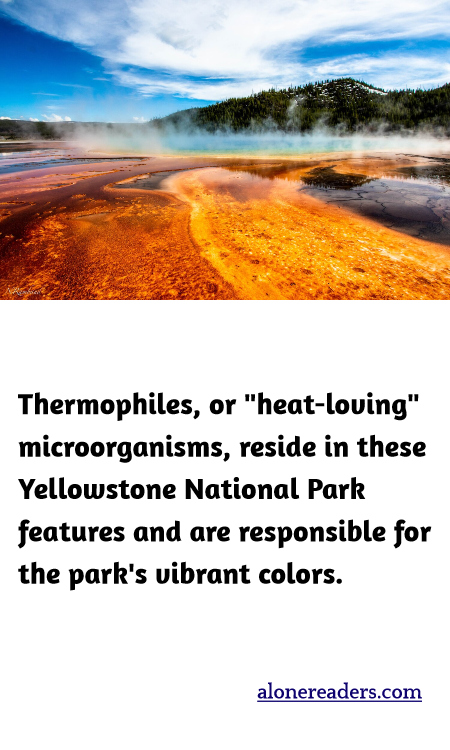
Thermophiles, microorganisms that thrive in extremely hot environments, play a crucial role in the iconic and vibrant landscapes of Yellowstone National Park. These "heat-loving" microorganisms are particularly abundant in the park’s geothermal features, such as hot springs, geysers, and mud pots. Yellowstone is a hotspot of geothermal activity, where the Earth’s heat, trapped just below the surface, powers these otherworldly features.
The term "thermophile" is derived from the Greek words "thermos," meaning heat, and "philos," meaning loving. These organisms have evolved unique adaptations that not only allow them to survive but to flourish at temperatures that would be lethal to most other forms of life. Typical environments for thermophiles include hot springs with temperatures that can exceed 122 degrees Fahrenheit (50 degrees Celsius).
One of the most visible contributions of thermophiles to Yellowstone’s allure is the brilliant palette of colors seen in areas like the Grand Prismatic Spring. The vivid blues, greens, yellows, and oranges that mesmerize visitors are largely due to the pigments produced by different thermophiles thriving at various temperature gradients within the hot springs. For instance, in the cooler outer regions of a hot spring, you might find orange and red hues produced by species of thermophiles such as Phormidium and Chloroflexi, which are adapted to cooler waters. Nearer to the center where the heat is more intense, organisms like Synechococcus show off bright blues and greens.
These organisms are not only remarkable for their resilience and role in the park's beauty but also hold significant scientific interest. Studies of thermophiles can offer insights into the mechanisms of thermotolerance — the ability of some organisms to withstand high temperatures — that could have applications in various industries, including pharmaceuticals and biotechnology. Furthermore, understanding how life exists in such extreme conditions on Earth also provides clues to how life might exist on other planets or moons in our solar system where conditions can be similarly extreme.
Thus, the thermophiles of Yellowstone National Park are a key attraction not just for their contribution to the park’s stunning visuals, but also for their intriguing implications in the realms of science and astrobiology. These organisms underscore the park’s value not only as a natural reserve but as a living laboratory for scientific exploration and discovery.
