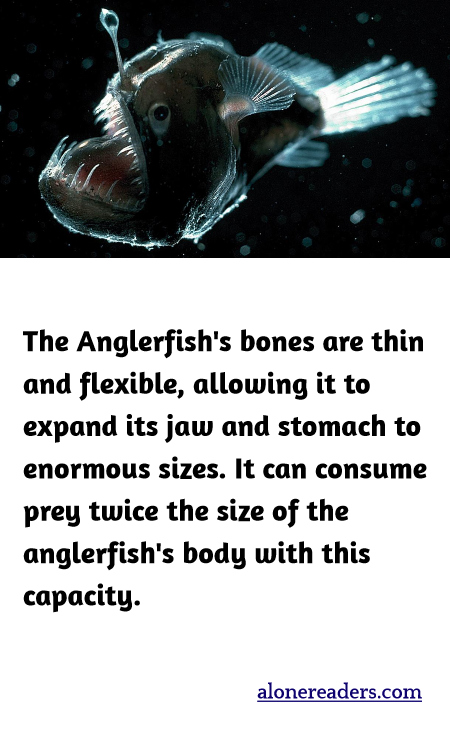
The anglerfish, a creature from the deep sea, is as fascinating as it is fearsome, largely due to its incredible skeletal adaptations. With bones that are both thin and flexible, the anglerfish is uniquely equipped to handle the challenges of its dark, high-pressure environment. This adaptability allows it to perform a rather startling feat: it can expand its jaw and stomach to swallow prey up to twice its size. This feature not only provides a survival advantage but also marks the anglerfish as one of the most formidable predators of the deep.
This ability to ingest prey larger than itself comes from the anglerfish's unique bone structure and the laxity of its skin and connective tissue. Unlike many other fish, whose sturdy skeletal structures support active swimming and regular feeding practices, the anglerfish's skeletal system is geared towards minimal energy expenditure. It spends much of its time floating slightly above the seafloor, conserving energy until a meal comes within reach.
Once potential prey is spotted—often attracted by the bioluminescent "lure" that dangles from the anglerfish’s head—the fish's jaw unhinges and its stomach extends dramatically. This rapid expansion forms a sort of vacuum, pulling the unsuspecting prey directly into the anglerfish’s gaping maw. The digestive process is slow, allowing the anglerfish to extract nutrients over a considerable period, which is crucial given the scarcity of food sources in the deep sea.
The adaptability of the anglerfish is a vivid example of how life forms can evolve specialized traits to thrive in extreme environments. These adaptations are not just crucial for the anglerfish's survival but also highlight the complex interactions within ecosystems and the evolutionary trajectories that can result from extreme environmental conditions. Understanding such mechanisms adds depth to our knowledge of biological diversity and the various survival strategies employed by life on earth.
