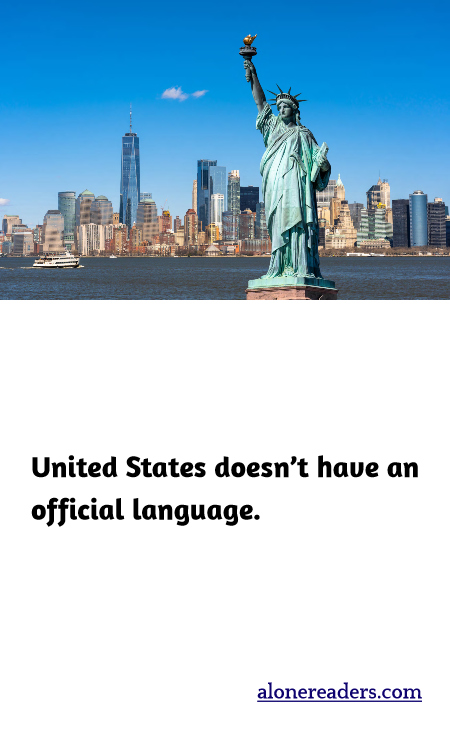
The United States is unique among nations in many ways, one of which is its lack of an official language at the federal level. Despite English being the dominant language used for government, business, and daily communication, it has never been formally designated as the national language. This characteristic reflects the country's complex linguistic landscape and its historical emphasis on individual rights and cultural diversity.
The roots of this situation can be traced back to the founding of the country, which was established by immigrants from a variety of linguistic backgrounds. The U.S. Constitution, written in 1787, made no mention of an official language. The framers, aware of the nation's diverse immigrant population, appeared to avoid imposing linguistic uniformity, likely to maintain peace among the different linguistic communities and to support individual freedom.
Throughout its history, the United States has seen waves of immigration, bringing a wide array of languages to its shores. Today, while the majority of Americans speak English, there are significant populations speaking Spanish, Chinese, Tagalog, Vietnamese, Arabic, French, and many other languages. This diversity is protected under the Civil Rights Act of 1964, which prohibits discrimination based on national origin, and by extension, language. Additionally, Executive Order 13166, signed in 2000, requires federal agencies and those receiving federal funds to provide services in multiple languages when needed, ensuring access to government services and participation in civic life.
The debate over an official language continues to surface in political discussions. Proponents argue that an official language would unify the nation, reduce government costs, and improve the assimilation of immigrants into American culture. Opponents, however, claim that such a move would be contrary to the nation's ideals of diversity and inclusion, potentially alienating large segments of the population and infringing on individual rights.
While numerous states have adopted English as their official language, these laws mainly affect state government operations and do not usually limit the provision of multilingual services where they are deemed necessary. For example, public schools across various states provide bilingual education programs, and election materials are often available in multiple languages, reflecting local demographic needs.
The absence of an official language in the United States underscores the country's commitment to diversity and the acknowledgment of its multicultural heritage. It is a reflection of a broader American ethos that values cultural pluralism, supports the rights of individuals to express their cultural identity, and recognizes the practical benefits of accommodating a multilingual population. As the United States continues to evolve, the discussion about an official language may persist, but it remains a key component of the nation's identity as a melting pot of cultures and languages.
