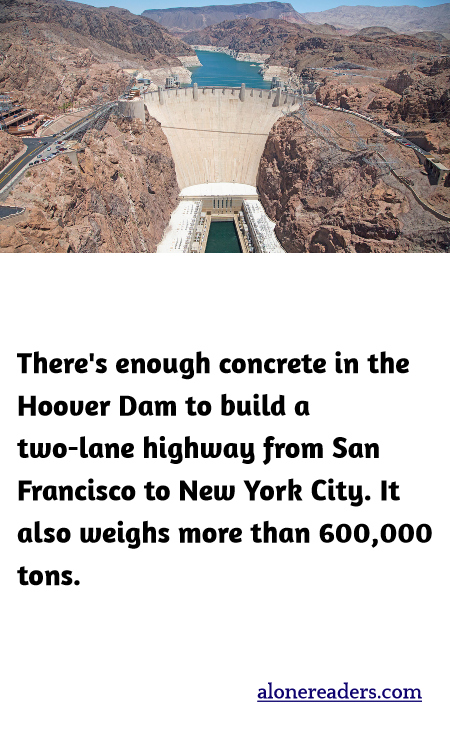
The Hoover Dam is not only an engineering marvel but also a testament to the capabilities of early 20th-century construction. This colossal structure, completed in 1936, stands as a pivotal achievement in American infrastructure. Located on the border between Nevada and Arizona, it holds back the Colorado River to form Lake Mead, the largest reservoir in the United States by volume when it's full. The dam was built primarily to provide flood control, water storage, and hydroelectric power.
Interestingly, the dam contains enough concrete to pave a two-lane highway from San Francisco to New York City, illustrating the massive scale of the project. This fact often astonishes people because it's a tangible representation that they can visualize—a cross-country road made entirely from the concrete of a single dam. The total amount of concrete used in the construction of the Hoover Dam is about 3.25 million cubic yards. This volume of concrete could build a highway approximately 3,000 miles long, covering the distance between these two major cities across the breadth of the United States.
Moreover, the Hoover Dam’s immense weight adds another layer to its grandeur. Weighing more than 600,000 tons, every aspect of the dam’s construction was monumental. This immense weight is necessary to counteract the pressure exerted by the 28.9 million acre-feet of water held in Lake Mead at full capacity. The weight and strength of Hoover Dam enable it to withstand the pressure and successfully fulfill its purpose.
The construction of the Hoover Dam was an unprecedented project for its time. It involved thousands of workers, and required innovations in engineering and construction techniques. For example, techniques were developed to cool the concrete faster to speed up the curing process, an essential step to manage such a vast quantity of material. The dam's design and construction became a model for future endeavors in dam engineering.
The Hoover Dam remains a crucial part of America's infrastructure. It is a source of hydroelectric power that supplies electricity to several states in the southwestern U.S., contributing to both economic and residential development. Additionally, it plays a vital role in water management for the arid regions of the Southwest, helping to irrigate agriculture and supply water to cities like Las Vegas and Los Angeles.
Today, apart from its functional purpose, Hoover Dam is a major tourist attraction, drawing visitors from around the world who come to marvel at its size and learn about its history and impact on the region. The dam is not only a symbol of American ingenuity and determination but a functional monument to the power of human resolve and technological advancement.
