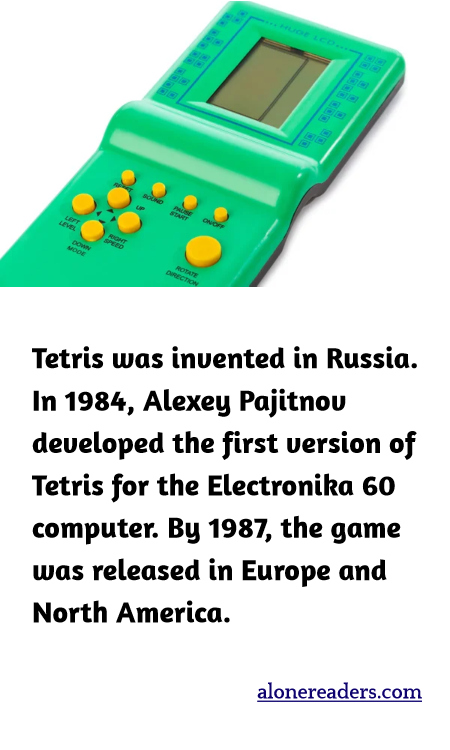
Tetris, the iconic tile-matching puzzle game, was conceived and developed in the Soviet Union by Alexey Pajitnov in 1984. Pajitnov, a software engineer at the Soviet Academy of Sciences, initially created the game to test new equipment and relieve the monotony of his daily tasks. He derived the game's name from the Greek numerical prefix "tetra-", as all of the game pieces contain four segments, and "tennis," his favorite sport.
Initially programmed for the Electronika 60, a Soviet-era computer, Tetris lacked graphics—the pieces were represented by text characters. Despite these humble beginnings, the game’s captivating and straightforward gameplay, where players must arrange falling blocks of different shapes to complete horizontal lines without leaving gaps, proved universally appealing.
By 1987, Tetris had made its way beyond the Iron Curtain, captivating Western audiences. Its international journey began when a software publisher from Hungary discovered the game at a trade show in Moscow. Realizing its potential, he bought the rights to distribute it. Shortly after, Tetris was ported to various platforms, including PCs and the immensely popular Game Boy. Nintendo's bundling of Tetris with every Game Boy sold proved to be a masterstroke, skyrocketing the game to global popularity and making it synonymous with portable gaming.
Tetris not only broke cultural barriers but also set new standards for puzzle games, emphasizing simplicity in design yet offering challenging and engaging gameplay. Its impact extends beyond just entertainment; researchers have studied its effects on the brain, demonstrating that playing Tetris can lead to more efficient brain activity and, in some cases, even help reduce emotional trauma if played soon after a traumatic event.
Today, Tetris remains a beloved and influential part of video game culture, with new versions and variants continuing to emerge. Its legacy endures, proving that a simple idea from 1984 can evolve into a global phenomenon that transcends generations and continues to captivate players around the world.
