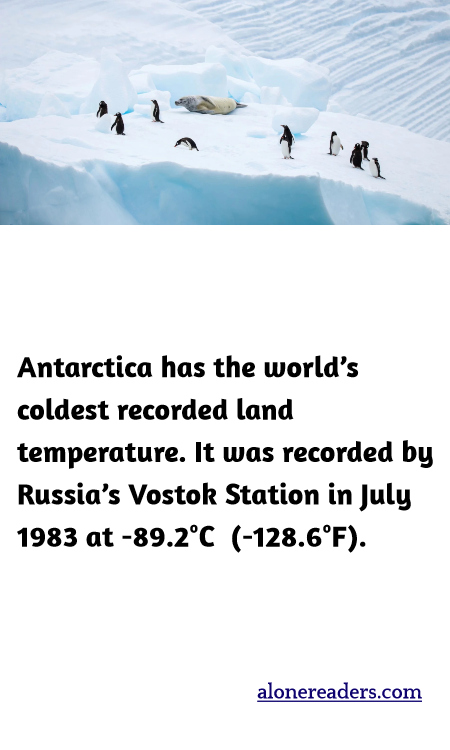
Antarctica, the southernmost continent on Earth, is renowned not just for its remote and icy expanses but also for holding the record for the lowest temperature ever recorded on the planet. This record-setting event took place at Russia’s Vostok Station in July 1983, when temperatures plummeted to a staggering -89.2°C (-128.6°F). This extreme temperature provides a stark illustration of the harsh conditions that prevail in this polar region.
Vostok Station, established by the Soviet Union in 1957, is situated near the center of the East Antarctic Ice Sheet. Its location is one of the most inhospitable places on Earth, which makes it an ideal spot for collecting scientific data crucial for understanding more about Earth’s climate and the history of its atmosphere. The record low temperature recorded there is attributed to several geographical and meteorological conditions unique to Antarctica including its high elevation, its position at the geomagnetic south pole, and its distant location from the moderating influence of oceans.
The impact of such extreme temperatures extends beyond just the scientific community. It poses significant challenges for survival – both for humans and wildlife. Only a few species, such as the emperor penguin, have adapted to these brutal conditions. Moreover, the extreme cold plays a critical role in Earth’s climate system. The vast ice sheets of Antarctica, formed over millennia, reflect a significant amount of solar radiation back into space, helping to regulate Earth's temperature.
The record of -89.2°C also serves as a reminder of the complexities involved in exploring and conducting research in such an extreme environment. It necessitates specialized equipment and procedures to ensure the safety and well-being of the researchers who brave these severe conditions to advance our understanding of the planet.
These studies and records from sites like Vostok Station are not only important in terms of scientific discovery but also for informing policy decisions regarding climate change and environmental preservation. Knowing how cold Earth can get, along with other data collected from such extreme environments, helps scientists predict weather patterns, understand climate change better, and develop strategies to mitigate its effects, safeguarding our environment for future generations. The extremities of Earth's climates, from the heat of Death Valley to the cold of Vostok Station, underline the planet's dynamic and ever-changing nature, reminding us of the continuous need for environmental stewardship.
