More About This Card
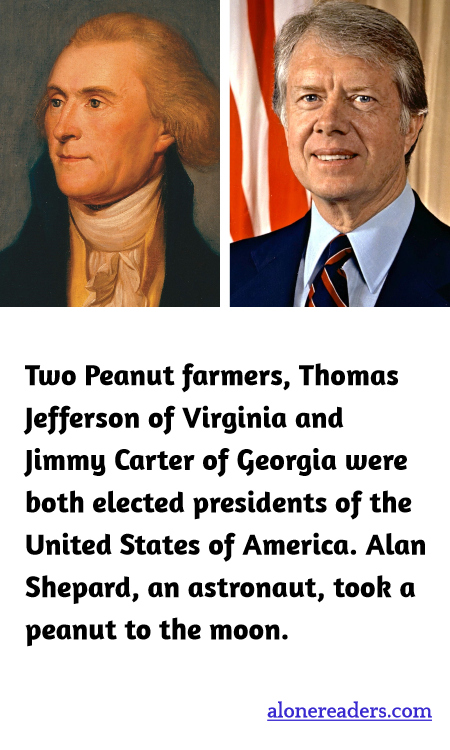
From the fertile fields of America to the vast expanse of the moon, peanuts have surprisingly threaded through the history of the United States not just as a popular snack, but also in the personal histories of some of its most interesting figures. Among them, two U.S. Presidents, Thomas Jefferson and Jimmy Carter, share the uncommon similarity of having been peanut farmers before their presidencies.
Thomas Jefferson, third President of the United States and a key figure in American history, was an ardent agriculturist who cultivated various crops on his Virginia plantation, Monticello. Among these crops were peanuts, which, during his time, were largely considered as fodder for livestock and a food for slaves. Jefferson’s contribution to peanut agriculture, although not as highlighted as his political accomplishments, underscores his broader interest in plant cultivation and agricultural innovation.
Many years later, Jimmy Carter from Georgia, who would become the 39th President, managed his family’s peanut farm before his political career. His deep roots in agriculture helped shape his values of hard work and simplicity, traits that resonated with many Americans. Throughout his campaign and subsequent presidency, Carter was often referred to as the “peanut farmer,” a moniker that emphasized his humble beginnings and grounded nature in the eyes of the public.
Interestingly, peanuts have not only featured in the agricultural and presidential history of the United States but also in its space exploration tales. Alan Shepard, one of the first astronauts of America and a significant figure in the Space Race, is said to have brought a peanut with him to the moon. Although this act could be seen as a whimsical or superstitious gesture, it symbolically highlights the ubiquity and grounding element of this simple legume, transcending its earthly ties.
These narratives not only underline the cultural significance of the peanut in American society but also illustrate a peculiar interconnection between agriculture, leadership, and exploration. Each figure’s relationship with peanuts reveals the multifaceted roles that this humble crop has played beyond just being a source of sustenance. It reflects the idea that greatness can sprout from the simplest of seeds, whether in the soil of a Virginia farm, the fields of Georgia, or even the surface of the moon. Both Jefferson and Carter showcased how their agricultural backgrounds shaped their views and governance, while Shepard’s lunar peanut epitomized the playful human spirit even in profound moments of historic significance. These stories collectively paint a picture of how a straightforward crop like the peanut wove its way into the fabric of American achievements and identity.