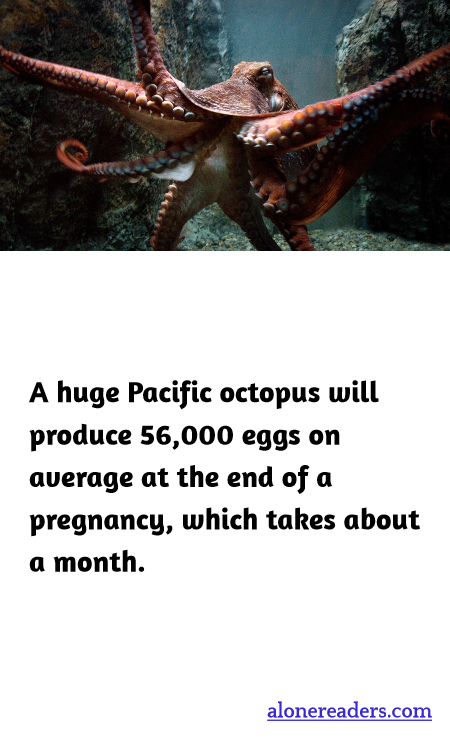
The reproductive journey of the giant Pacific octopus, one of the largest and most fascinating members of the cephalopod class, culminates spectacularly with the production of an extraordinary number of eggs. On average, a female will lay about 56,000 eggs towards the end of her life— a striking figure that underscores the balance of marine life survival strategies.
The process leading up to the laying of these eggs is as intriguing as the creature itself. Typically, the gestation period lasts about a month, during which the female octopus finds a safe, secluded spot to make her den. This location is crucial as it serves as the nursery for her future offspring and a fortress protecting them from predators. The den might be in the crevice of a rock or a similarly sheltered area in the deep sea.
Once the eggs are laid, the maternal instincts of the giant Pacific octopus kick into overdrive. Unlike many marine creatures that abandon their eggs post-spawning, the female octopus assumes the role of a devoted protector. She continuously guards her eggs, fanning them with her arms to ensure a steady flow of oxygenated water which is essential for healthy development. During this time, the female does not leave her eggs to feed, and she gradually weakens.
This dedication underscores the high mortality rate among octopus hatchlings; only a few of the tens of thousands of eggs laid will survive to adulthood. The vast number of eggs produced compensates for the immense predation risks that the small, vulnerable hatchlings will face once they venture into the ocean currents.
Upon hatching, the young octopuses, or paralarvae, are minuscule and planktonic. Initially, they float with plankton clouds where they must evade predators, secure enough food, and grow. If they survive this critical early phase, they gradually descend to the ocean bottom to begin their lives in a more controlled environment similar to that of adult octopuses.
The reproductive cycle of the giant Pacific octopus is both a testament to the harsh realities of oceanic life and a remarkable example of evolutionary adaptation. While the female inevitably dies shortly after her eggs hatch, her sacrifice ensures the continuation of her species. Each spawning season thereby contributes to the rich biodiversity of the marine ecosystem, playing a crucial role in its maintenance and stability.
