More About This Card
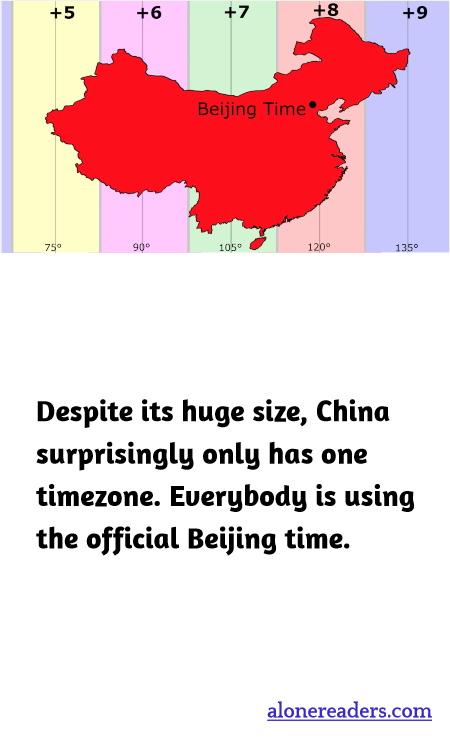
Despite spanning over 5,000 kilometers from west to east and covering the same geographic area as the United States, China operates on a single standard time zone: Beijing Time (UTC+8). This was not always the case. Until 1949, China had five different time zones. However, to promote national unity and efficiency following the Chinese Civil War, the Communist government decided to adopt a single time zone.
Implementing one time zone across such a vast territory comes with its challenges and peculiarities. For residents in the far western regions, such as Xinjiang and Tibet, the impact is most noticeable. In these areas, the sun might not rise until as late as 10:00 AM in the winter and sets long after 9:00 PM in the summer. This unusual schedule means local habits and business hours often shift significantly from those in the east. Many residents choose to follow an unofficial local time in their daily lives, which can be two to three hours behind Beijing Time.
The use of a single time zone is meant to aid in the administrative, military, and economic cohesion of the country. Communications and transport run more efficiently under one time standard. For instance, train schedules and national broadcasts operate strictly according to Beijing time, which simplifies cross-regional planning and operations. Moreover, having one time zone reinforces the political notion of national unity and centralized control, which are important aspects of the Chinese government's governance philosophy.
However, this system has its critics, especially as it affects health and productivity. The misalignment between social and biological time can lead to a phenomenon known as "social jet lag," where people's natural sleep cycles are disrupted by the need to adhere to a socially-imposed time structure. This can contribute to various health issues like poor sleep quality and reduced cognitive function.
Despite these challenges, the idea of introducing additional time zones has not gained much traction within the government or among the population. For now, China continues to demonstrate that a single time zone, while not without its difficulties, plays a role in the country's strategy for maintaining cohesion and simplifying the functions of a vast and varied nation.