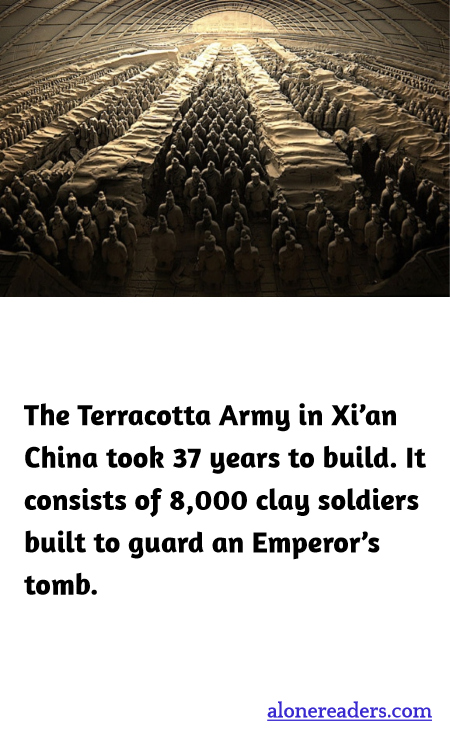
The Terracotta Army, a collection of terracotta sculptures depicting the armies of Qin Shi Huang, the first Emperor of China, is a form of funerary art buried with the emperor in 210–209 BCE with the purpose of protecting him in his afterlife. Located in Xi’an, China, this extraordinary army is a testament to ancient Chinese artistry and their beliefs in the afterlife. Constructed to accompany the tomb of Emperor Qin Shi Huang, the first emperor who unified China, the army consists of over 8,000 soldiers, each one distinct, with their features, expressions, and even hairstyles crafted in meticulous detail.
The creation of this vast army is a feat of labor and artistry that unfolded over 37 years, employing thousands of workers, artisans, and craftspeople. The terracotta soldiers vary in height, uniform, and posture according to their roles, which include infantrymen, archers, and cavalrymen, alongside chariots and horses. What makes the Terracotta Army even more fascinating is the level of individuality each statue possesses, a reflection of the incredible craftsmanship of ancient Chinese sculptors who used local clay and baked the figures at high temperatures.
The site where the Terracotta Army was found is part of a larger necropolis, intended to be a microcosm of the emperor’s palace and power. It was discovered in 1974 by local farmers drilling a water well to the east of Xi’an. Since then, the site has become one of China’s primary tourist attractions, contributing significantly to the understanding of China's history and the life of its first emperor.
Despite decades of excavation and research, much of the necropolis remains unexplored, which includes the central tomb of Emperor Qin Shi Huang himself. This ongoing mystery adds an aura of mystery to the already captivating site. The Terracotta Army not only encapsulates the might of the Qin Dynasty but also showcases the incredible artistic and cultural strides made during this period. These terracotta soldiers have stood in silent guard for over two millennia, and today, they serve as a vivid historical testament to China’s past, seen by millions of visitors from around the globe each year.
