More About This Card
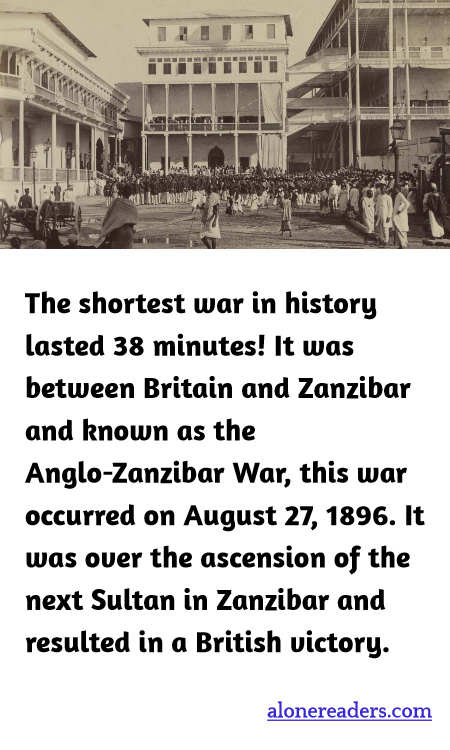
The Anglo-Zanzibar War of August 27, 1896, holds the record as the shortest war in history, lasting a mere 38 minutes. The conflict arose from a succession dispute in the Zanzibar Sultanate, located off the coast of what is now Tanzania. When Sultan Hamad bin Thuwaini, who had been a pro-British ruler, died suddenly on August 25, 1896, his nephew, Sultan Khalid bin Barghash, seized the throne without British approval. The British authorities, determined to install a ruler who would align with their interests, issued an ultimatum to Khalid to step down.
Khalid, however, was resolute in maintaining his claim to the throne and barricaded himself in the Zanzibar palace, amassing around 2,800 men and fortifying the palace with artillery. In response, the British mobilized a formidable force that included three cruisers, two gunboats, and around 150 marines and sailors. On the morning of August 27, with the ultimatum expired and no sign of compliance from Khalid, the British ships opened fire on the palace at precisely 9:02 AM.
The bombardment was devastating. The palace's wooden structure was highly susceptible to incendiary shells, and a fire soon broke out, destroying the Sultan’s artillery and forcing him to quickly flee. By 9:40 AM, Khalid had escaped to the German consulate where he sought asylum. The British ceased fire and declared the war over.
In the aftermath, the British quickly installed Sultan Hamoud bin Mohammed, who was more agreeable to their directives, particularly concerning the abolition of the slave trade in the region. The swift and decisive victory underscored British naval supremacy and marked a critical moment in the colonial history of East Africa. Khalid was later captured and exiled to Seychelles, while the British bolstered their control over Zanzibar, which became a protectorate.
The Anglo-Zanzibar War, though brief, had lasting implications on the colonial landscape of East Africa, demonstrating the lengths to which imperial powers would go to secure their interests and influence in the region. It remains a remarkable historical footnote due to its extraordinarily short duration and the decisive nature of its outcome.