More About This Card
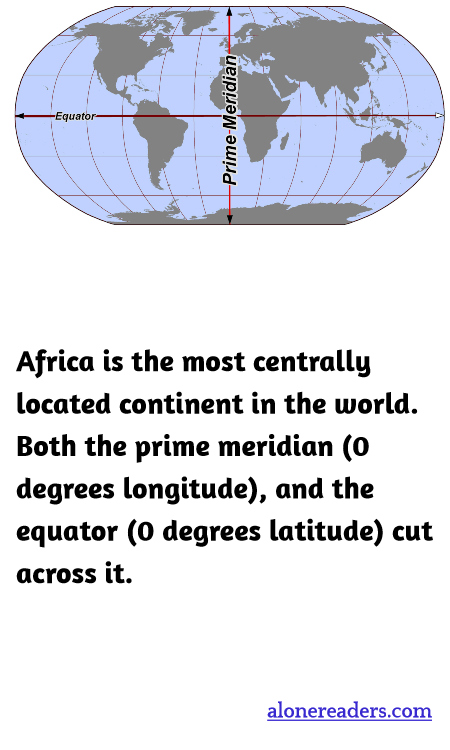
Africa's geographical positioning is unique among the continents, being the only continent traversed by both the prime meridian and the equator. This central location has profound implications for its climate, biodiversity, and the cultural diversity of its human inhabitants. The equator, which is the line of zero degrees latitude, slices across Africa near the middle, passing through countries such as Gabon, Congo, the Democratic Republic of Congo, Uganda, Kenya, and Somalia. This equatorial placement bestows a warm climate year-round, with many of these regions experiencing a tropical climate characterized by substantial amounts of rain and high temperatures throughout the year.
On the other hand, the prime meridian, or zero degrees longitude, passes through Ghana and Algeria, providing a symbolic bridge between the Eastern and Western hemispheres. This longitudinal crossing is less impactful on climate but does play a significant role in timekeeping and serves as a reference point from which time zones are calculated.
The intersection of these two global lines within Africa not only underscores its geographic centrality but also enhances its metaphorical status as a crossroads of the world. This centrality has historically facilitated both the mingling and clashing of various civilizations and empires, from the Phoenicians and Carthaginians in the north to the Zulus and Matabele in the south. Moreover, it has created a cradle for human evolution and development, with archaeological findings dating back millions of years, suggesting that human life indeed started in Africa.
Furthermore, Africa's climatic zones vary dramatically from the north to the south and from the east to the west, influenced by both the equator and the varying elevations across the continent. The Sahara Desert, the largest hot desert in the world, dominates the northern landscape, while vast savannahs and rainforests dictate much of central Africa's ecosystem. Southern Africa features a mixture of both, plus temperate grasslands. These diverse habitats support an incredible variety of wildlife, making Africa one of the most biodiverse continents on the planet.
The cultural implications of Africa's central position are also significant. The continent's historical role as a center of trade—including the trans-Saharan trade routes, the Swahili coast's trade in the Indian Ocean, and more somberly, the Atlantic slave trade—has shaped a rich tapestry of cultural exchange. Languages, religions, and traditions from Africa have spread worldwide and have also adopted and adapted influences from other continents due to this extensive contact.
In conclusion, Africa's position at the intersection of the equator and the prime meridian is more than a geographical curiosity; it plays a fundamental role in shaping the continent's climate, ecology, and human culture. This central placement underscores Africa's role as a historical meeting point for various global influences, making it a perennial focal point in global affairs.