More About This Card
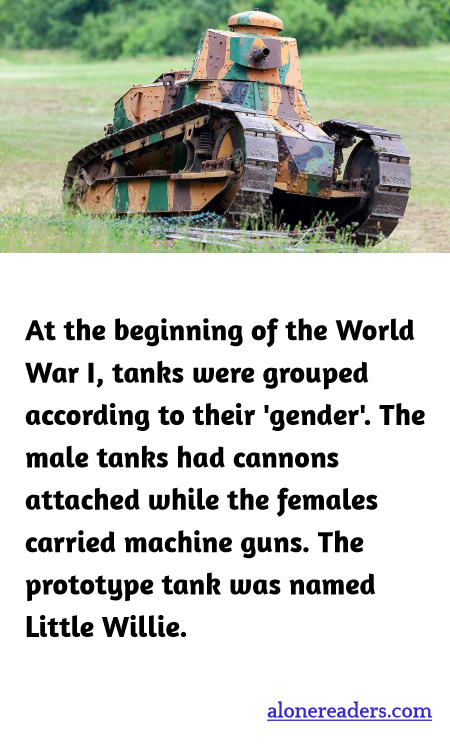
During the early stages of World War I, as military technology rapidly evolved amidst the demands of warfare, the invention of the tank marked a significant turning point. Reflecting the era’s conventional gender notions, the first tanks were categorized into 'males' and 'females' based on their armaments. Male tanks were equipped with cannons used primarily to destroy fortifications and engage enemy armored targets. They bore heavier, larger-caliber guns capable of dealing significant damage to structures and other tanks. On the other hand, female tanks were outfitted with multiple machine guns intended for infantry support and targeting enemy troops. This differentiation in roles was designed to maximize each gendered tank’s effectiveness on the battlefield by utilizing their respective firepower against appropriate targets.
The prototype of these groundbreaking armored vehicles was affectionately named "Little Willie." Developed by the British in 1915, Little Willie was the world's first functional tank. Although primitive by later standards, its creation represented an innovative departure from traditional warfare, introducing a new dimension to land battles. The distinctive rhomboid shape designed to navigate the challenging, trench-marred landscapes of the Western Front soon became characteristic of early tank designs. Despite Little Willie never seeing combat itself, it served as a critical foundation for subsequent models, which continued to evolve throughout the war.
The concept of "male" and "female" tanks, although initially practical in simplifying the roles and capabilities of these early armored vehicles, eventually became obsolete. As technological advancements continued, the distinction blurred, with later tanks combining features of both types into a single, more versatile platform. The experience of using gender-segregated tanks, however, highlighted the experimental and adaptive nature of wartime innovation—a theme that persisted across various facets of military technology during the conflict. These initial categorizations and experiments like Little Willie laid the groundwork for the highly sophisticated and powerful tanks seen in later military engagements around the world.