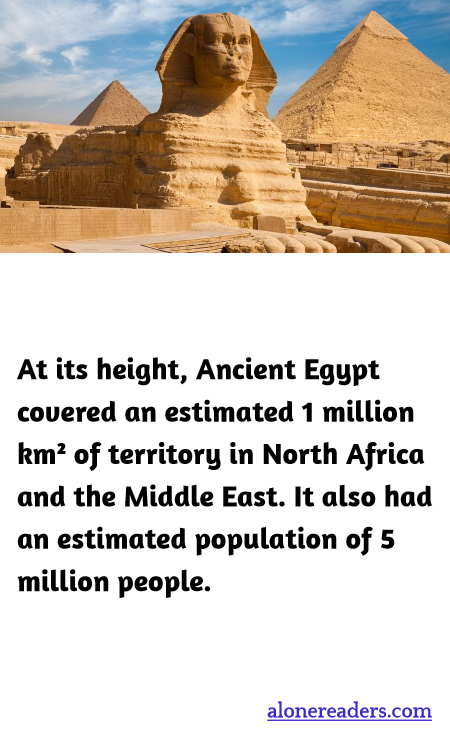
Ancient Egypt, one of the world's earliest and most enduring civilizations, flourished from around 3100 BCE to 30 BCE. At its peak, this sophisticated society extended its influence and control over a swath of approximately 1 million square kilometers, encompassing not just the fertile Nile River Valley but also spreading into parts of the modern-day Middle East. This vast territory allowed Egypt to become a melting pot of cultures, technologies, and ideas.
The population of Ancient Egypt is estimated to have reached around 5 million people during its zenith. This considerable number is reflective of the innovative agricultural techniques employed by the Egyptians, which maximized the arable yield of the Nile Valley. The Nile's annual flooding replenished the soil's nutrients, enabling the production of surplus crops which in turn supported a dense population.
Social organization was also a significant factor in sustaining this large population. The Egyptians established a hierarchical system with the Pharaoh at the top, followed by a tiered structure of officials, priests, scribes, artisans, and farmers. This social stratification ensured efficient administration and distribution of resources, crucial for managing such a populous society.
Culturally, Ancient Egypt was a leader in many fields, including architecture, art, and science. The grandiose pyramids, which served as monumental tombs for the pharaohs, are testament to their architectural innovation and engineering skills. Egyptian artisans, with their advanced knowledge of chemistry, developed a glass-making technique and produced faience, a type of glazed ceramic that was highly valued in trade. Scholars and scribes in Egypt also made significant advances in medicine and mathematics, setting foundations that would influence later cultures around the Mediterranean and beyond.
Thus, the territories controlled by Ancient Egypt were not just a testament to its military prowess but also a reflection of its cultural and technological advancements. This broad dominion supported a remarkably dense population for the time, facilitated by innovative agricultural practices and a structured social hierarchy, which altogether fostered a civilization that was as vibrant as it was influential. As such, Ancient Egypt’s historical and cultural legacy continues to be felt worldwide, shaping modern understandings of governance, architecture, science, and art.
