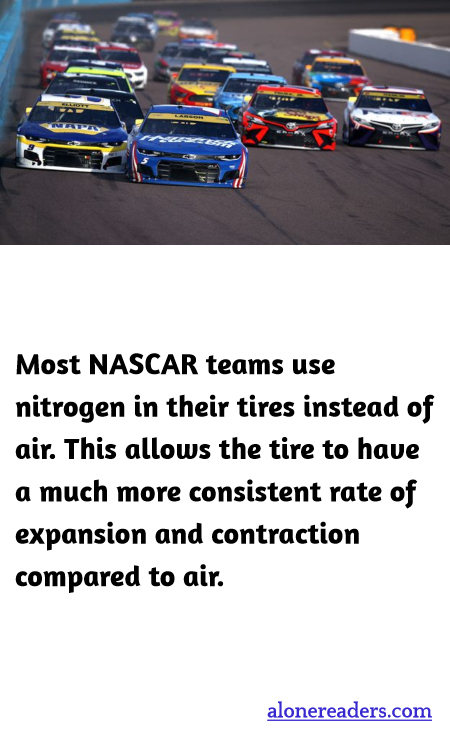
In the high-stakes world of NASCAR racing, even minor details can be the difference between victory and defeat. One such detail is the choice of gas used to inflate the tires of the race cars. Most NASCAR teams opt to use nitrogen instead of regular air in their tires, a practice that might seem trivial but has significant implications on performance.
The primary reason for using nitrogen is its ability to maintain tire pressure at a more consistent level compared to air. Regular air is composed of approximately 78% nitrogen, 21% oxygen, and 1% other gases. Oxygen is more reactive and permeable than nitrogen. This means that oxygen can escape more easily from tires and reacts at different rates under varying temperatures, which can change the pressure inside the tire.
Nitrogen, on the other hand, is less reactive and has larger molecules, which makes it less likely to seep through the microscopic pores of tire walls. This results in a more stable tire pressure across different temperatures and racing conditions. Consistent tire pressure is crucial in racing because it affects the handling, speed, and safety of the vehicle. Fluctuations in tire pressure can lead to decreased performance and can even pose safety risks during a race.
Moreover, nitrogen is less likely to hold moisture compared to air. Moisture in tires can lead to variations in pressure and can cause the tires to degrade more quickly. By using nitrogen, NASCAR teams can reduce the risk of moisture-related issues, ensuring that the tires perform optimally throughout the race.
The practice of using nitrogen in tires is not just limited to NASCAR but is also common in other forms of racing and in industries where tire performance is critical, such as in aviation and Formula 1 racing. For everyday passenger vehicles, the benefits of using nitrogen are less pronounced, but for NASCAR, where every fraction of a second counts, the stability and reliability offered by nitrogen can be a significant advantage.
Thus, the use of nitrogen in NASCAR tires highlights the importance of engineering and materials science in sports, where innovative practices can help teams maintain a competitive edge. By focusing on every component of the race car, including something as seemingly simple as the type of gas in the tires, NASCAR teams can enhance overall performance and safety on the track.
