More About This Card
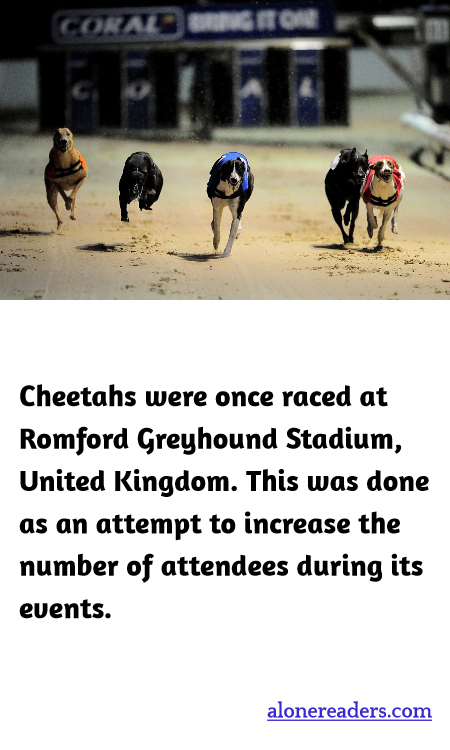
In the early 1930s, in an unconventional bid to boost attendance, the Romford Greyhound Stadium in the United Kingdom introduced cheetah racing as part of its catalogue of attractions. Traditionally, greyhound racing was the main spectacle at the stadium, which drew a significant number of spectators. However, during periods of lower attendance, management experimented with various entertainment strategies. Cheetah racing was seen as a novel and thrilling alternative that could potentially draw large crowds eager for the unique and exotic.
The idea was as unusual as it was simple: racing cheetahs, the world's fastest land animals, capable of reaching speeds up to 75 miles per hour in short bursts. Officials at the stadium arranged for several cheetahs to be brought from Africa, as showcasing these magnificent and speedy animals raced against one another was presumed to be an irresistible draw. Cheetahs were matched against greyhounds, and sometimes they solo raced against time, providing a spectacle of unmatched raw speed.
However, this experiment in entertainment didn't play out as planned. Firstly, there were practical difficulties in managing cheetahs, which, unlike dogs, are wild animals not accustomed to racing on command or following a track. Their care and management required specialized skills and precautions. Secondly, ethical concerns soon arose. Animal rights groups and the general public expressed worries about the welfare of the cheetahs, arguing that the high-stress environment of a race track was not a humane setting for such wild creatures.
The races also faced logistical issues including the frequent failure of cheetahs to follow the intended course of the track, leading often to chaotic and underwhelming performances. Moreover, the variety in performance added uncertainty as cheetahs, unlike greyhounds, do not have a natural inclination to chase a mechanical lure.
Understanding the various issues and responding to the public's changing attitudes towards the use of animals for entertainment, the use of cheetahs as race participants was relatively short-lived at Romford. The stadium soon reverted back to traditional greyhound racing, and over time, the cheetah races became an intriguing yet controversial footnote in the history of British sporting.
Cheetah racing at Romford Greyhound Stadium left a mark on the historical narrative of sports and entertainment, underscoring a time when the quest for greater public engagement occasionally led to the crossing of ethical boundaries. This moment in history provides an important reflection on animal welfare and the evolution of societal norms surrounding the use of animals in public spectacles.