More About This Card
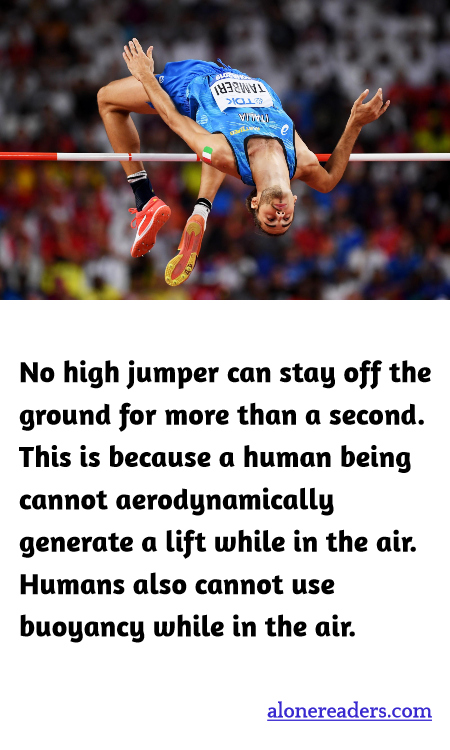
High jumping is a sport that combines speed, strength, and agility, allowing athletes to momentarily defy gravity and clear heights that are impressive to onlookers. While these athletes can create the illusion of flying as they soar over the bar, the actual time they spend off the ground is extremely brief – not exceeding one second. This limitation is fundamentally due to the laws of physics that govern our human abilities and the environment in which we live.
Humans, unlike birds or insects, lack the necessary anatomy to generate aerodynamic lift. Birds have wings which they can flap to create lift and sustain flight. Insects, too, have wings that beat at incredibly high frequencies, enabling them to hover and navigate through the air. Humans, on the other hand, have no such adaptations. Our body structure comprises a rigid skeletal frame designed for support and mobility on land, not for flight. The muscle power and speed a high jumper can generate only provide enough force to fight against gravity momentarily.
Moreover, buoyancy, which allows objects like boats or submarines to float and maneuver in water by displacing a volume of water equal to their weight, does not assist humans in the air. Air, being much less dense than water, provides virtually no buoyant force that would be substantial enough to have any noticeable effect on the human body’s ability to stay airborne. The density and viscosity of air are such that they cannot support a human body by buoyancy as water does for boats.
As a result, the spectacle of high jumping is not about sustained air time but about the incredible ability of athletes to utilize their strength and technique to maximize their vertical jump height. Athletes train rigorously to perfect their approach, takeoff, and flight technique to optimize every millisecond they are above the ground. Techniques such as the Fosbury Flop, where the jumper arches their back over the bar while facing the sky, have been developed specifically to maximize the height cleared relative to the center of mass of the jumper.
Therefore, while it might seem like high jumpers are defying gravity for an extended time, they are actually showcasing a rapid, explosive movement that is over almost as soon as it begins. The constraints of human physiology and physics firmly anchor these athletes to the ground, limiting their flight to under a second. Yet, within that brief moment, high jumpers achieve feats that continue to captivate and impress, pushing the boundaries of what is possible within those limits.