More About This Card
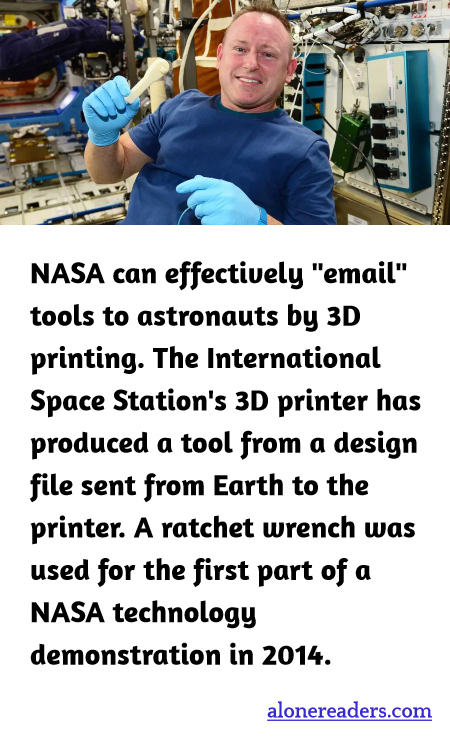
Innovations in technology have repeatedly pushed the boundaries of what is possible in space exploration, with one of the more futuristic advancements being the ability to "email" tools to astronauts. This process, made possible through the use of 3D printing technology, was vividly demonstrated in 2014 when NASA successfully sent a digital file from Earth to the International Space Station’s (ISS) 3D printer, which then created a usable ratchet wrench. This marked a significant milestone for space missions, offering a glimpse into the potential of on-demand tool production in space.
The implications of this technology are profound. Astronauts can potentially manufacture necessary tools on-the-fly during long-duration space missions, such as those to Mars or other distant destinations. This capability not only reduces the need for extensive lists of spare parts to be sent from Earth – thus cutting down on launch costs and payload weights – but it also provides crew members with immediate solutions to unforeseen problems. In the past, if a specific tool was missing or broke, the only solution was to wait for the next supply mission. However, with onboard 3D printers, astronauts can simply print out the tool or object they need after receiving the design file from Earth.
The current use of 3D printing on the ISS serves not only as a convenient way to replace or upgrade existing tools and parts but also as a crucial experiment in autonomous in-situ manufacturing, which will be essential for the future of interplanetary travel. As astronauts strive toward establishing permanent bases on the Moon or Mars, the ability to source materials and produce necessary components on location from available resources will be indispensable. This technology paves the way for using regolith, the loose rocky material on the moon's surface, to print anything from building materials to machine parts, fundamentally supporting sustained human presence beyond Earth.
As advancements in 3D printing technology continue, its potential applications in space continue to expand. Researchers are exploring the use of bioprinting for medical applications, such as creating tissue that could be used to treat astronauts. The integration of 3D printing into space missions underscores a broader movement towards more sustainable and adaptable methods of space exploration, highlighting how innovations developed for space can also have significant benefits on Earth by pioneering new ways of manufacturing and problem-solving. This form of technology not only delivers practical solutions to present challenges but also opens up myriad possibilities for future exploration and habitation.