More About This Card
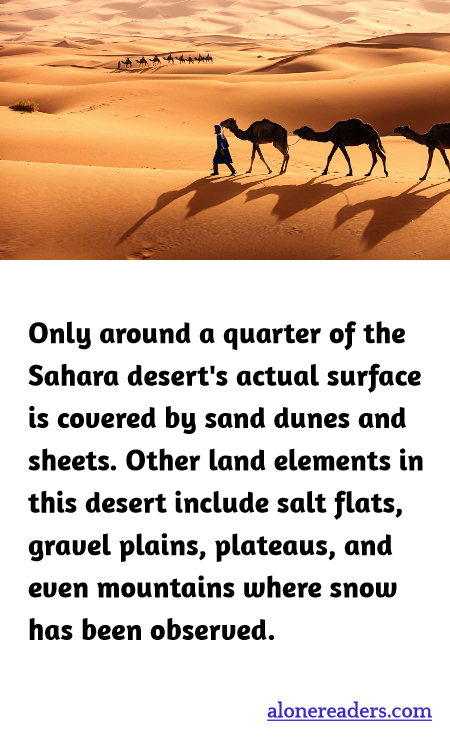
The Sahara Desert, often visualized as a vast expanse of rolling sand dunes, is much more diverse in its geographical makeup than many might assume. It is true that iconic golden dunes and sandy sheets make up about 25% of this enormous desert, yet the Sahara's landscape is much more varied and complex. Beyond the dunes, the desert features a range of other geographical elements that contribute to its unique ecosystem and stark beauty.
One of the prominent features of the Sahara is its extensive salt flats. In areas like the Qattara Depression in Egypt, these salt flats create a surreal, almost otherworldly landscape that stretches to the horizon, offering a stark contrast to the golden sand dunes. These flats are mostly composed of hard, crusty surfaces formed from evaporated historical bodies of water, leaving behind vast quantities of minerals and salts.
Gravel plains constitute another significant part of the Sahara's terrain. These plains, known as reg, are composed of a thick layer of angular and fragmented rocks, offering little sustenance for flora and fauna but playing a vital role in the desert’s ecology. They cover even larger areas than the sand seas and are characteristic of the desert landscapes found in countries like Morocco and Algeria.
Moreover, the Sahara is not uniformly flat and lifeless. It encompasses several mountain ranges, such as the Tibesti Mountains in Chad and the Ahaggar Mountains in Algeria. These rugged peaks rise dramatically from the desert floor, challenging the stereotypical image of the Sahara. Incredibly, these mountains are not just rocky barren lands; during winter, their highest peaks are sometimes capped with snow, providing a spectacle that is as surprising as it is beautiful.
These varied landscapes not only offer a visual diversity but also create different microenvironments within the desert. For instance, the mountainous regions support relatively more biodiversity, including various types of vegetation and wildlife, compared to the arid gravel plains or salt flats.
Understanding the diverse geography of the Sahara is essential for appreciating the complexity of its ecosystem and the challenges it faces due to environmental changes. Despite its harsh conditions, the Sahara remains one of the most fascinating and diverse natural landscapes on Earth, far beyond the simple sea of sand many imagine it to be.