More About This Card
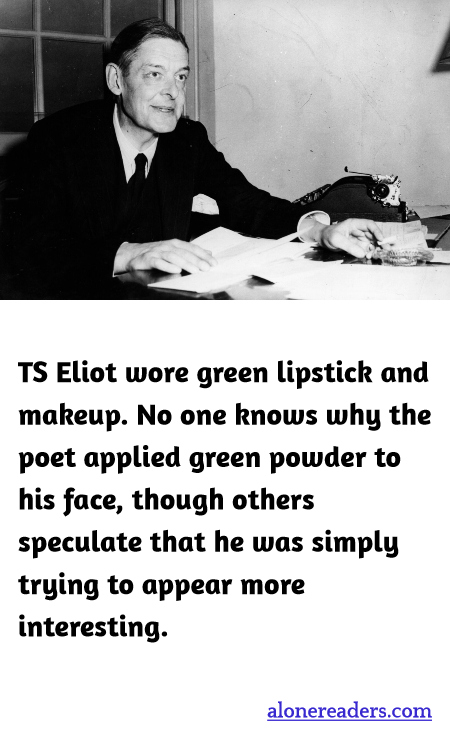
T.S. Eliot, one of the most eminent figures in literary modernism, had a peculiar facet to his persona that has intrigued scholars and fans alike: his reported penchant for green lipstick and makeup. Although this aspect of his personal life is less documented and somewhat shrouded in mystery, it provides a fascinating glimpse into the complex character of a man best known for his profound and densely allusive poetry.
The reason behind Eliot's choice of green makeup remains largely speculative. Some suggest that it was a quirky attempt to cultivate a more intriguing or flamboyant public image, a stark contrast to his otherwise somber and austere persona. He was, after all, a man who donned the conventional banker's suit by day during his time at Lloyds Bank, managing his dual roles as a banker and a poet. The green lipstick might have been a personal rebellion, a small yet colorful escape from his conservative lifestyle.
Others consider the possibility that this choice was linked to his literary symbolism, an extension of the themes of despair and disillusionment that permeate his works like "The Waste Land" and "The Love Song of J. Alfred Prufrock". Green, in many cultures, symbolizes rebirth and regeneration, but it can also denote decay and toxicity—themes Eliot explored extensively in his poetry. The green makeup could thus be seen as a living metaphor, worn outwardly to reflect his inner literary world.
Interestingly, this odd habit—if it was a habit—did not seem to detract from Eliot's stature and might have even enhanced the enigmatic aura that surrounded him. In any case, whether as a personal statement or a public spectacle, the visual of Eliot with green makeup feeds into the larger mythos of a man who was as complex personally as he was profound poetically.
Despite the absence of concrete explanations, the image of Eliot in green lipstick remains a compelling footnote in the study of a man who mastered the art of presenting the human experience in vividly original terms. It reinforces the idea that poets often live the poetry they write, blurring the lines between their art and their everyday lives. In Eliot's case, perhaps his face was just another canvas for his modernist expressions, a live performance of the existential and often surreal narratives he crafted in his work.