More About This Card
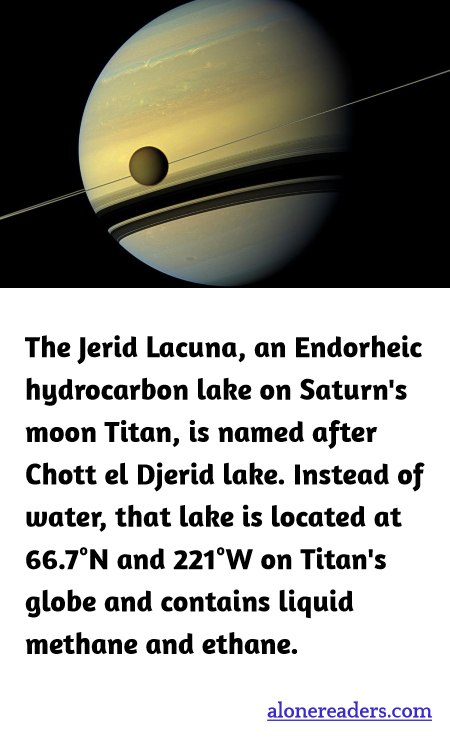
Saturn's moon Titan is known for its striking similarities to Earth, despite its extreme and alien conditions. One of the most fascinating features of Titan is the Jerid Lacuna, an endorheic hydrocarbon lake uniquely composed of liquid methane and ethane, instead of water. This lake draws its name from the Chott el Djerid, a large salt lake in Tunisia on Earth, highlighting the thematic connections scientists often make between Titan’s geographic features and those of Earth.
Located at the coordinates 66.7°N and 221°W on Titan, Jerid Lacuna offers a compelling glimpse into the complex hydrological cycle on Titan, which mirrors Earth’s water cycle but with a frigid twist. On Titan, temperatures plummet to about -179 Celsius (-290 Fahrenheit), a stark contrast to any climate on Earth, allowing methane and ethane to exist in liquid form. These hydrocarbons play a similar role to water on Earth, shaping the moon’s surface through processes like erosion, and possibly even creating conditions favorable for some form of life, albeit in a form vastly different from terrestrial life.
The study of Jerid Lacuna, as with other lakes on Titan, is crucial for understanding not only Titan’s ecology but also broadening our understanding of possible life-supporting environments beyond Earth. Space missions, such as the Cassini probe that orbited Saturn and provided detailed images and data about Titan, have opened windows into these alien lakes, revealing their composition and the dynamic weather patterns of this distant moon. The data suggest that these lakes are not static but change with Titan’s seasons, which last for about seven Earth years.
The insights gathered from features like Jerid Lacuna are invaluable as scientists continue to explore our solar system’s boundaries and the potential habitability of other worlds. It’s a reminder of the universe's vastness and the variety of natural phenomena that occur within it, urging humanity to keep looking upward and outward, pushing the limits of exploration and understanding.