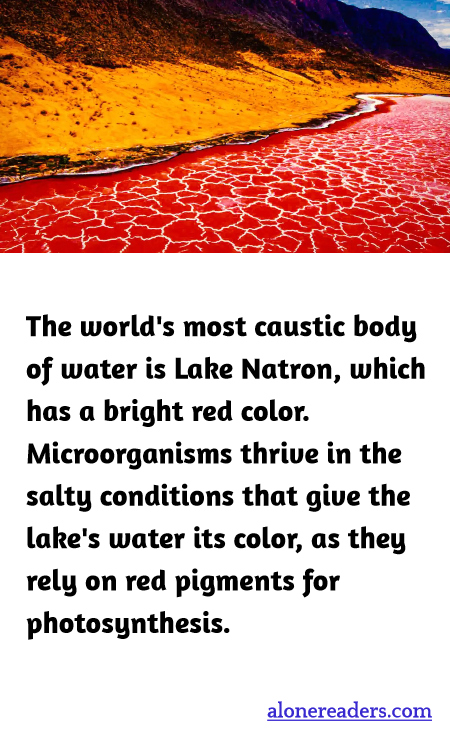
Lake Natron, located in northern Tanzania in East Africa, stands out as one of the most inhospitable environments on Earth due to its extremely alkaline water. This lake's pH typically ranges between 9 and 10.5, making it one of the world's most caustic bodies of water. The high alkalinity comes from the sodium carbonate and other minerals that flow into the lake from the surrounding hills. In ancient Egypt, sodium carbonate was used in the mummification process, hence the nickname "Natron" which arises from this historical use.
The water in Lake Natron is often observed as having a striking red or pink hue. This unusual coloration is due to the presence of salt-loving microorganisms that thrive in its salty, high-pH environment. Among these organisms are cyanobacteria, which have red pigments that allow them to perform photosynthesis more efficiently under these specific conditions. This adaptation not only contributes to their survival but also imparts the characteristic red color to the lake.
Despite its harsh conditions, Lake Natron supports a unique ecosystem. It serves as a nesting ground for the lesser flamingo, which breeds there due to the lake's isolated location and the availability of abundant Spirulina algae, which thrive in its waters. These algae serve as a primary food source for the flamingos, helping them to maintain their brilliant pink color. Oddly enough, the very toxicity of the water which deters predators helps protect flamingo nests from natural enemies.
However, the extreme environment of Lake Natron poses challenges to most other forms of life; few organisms are able to withstand its harsh conditions. The water is highly caustic and can cause burns to the skin and eyes of animals not adapted to its environment. For instance, calcification, where animals are turned into mummies, can occur when they come into contact with the water, leaving behind eerily well-preserved remains.
The surreal, otherworldly beauty of Lake Natron and its scientific fascination make it a subject of interest for ecologists and geologists around the world. While it might not be an ideal destination for a typical swim or water sports, Lake Natron offers a vivid example of life’s adaptability in even the most extreme conditions, echoing the incredible resilience of nature.
