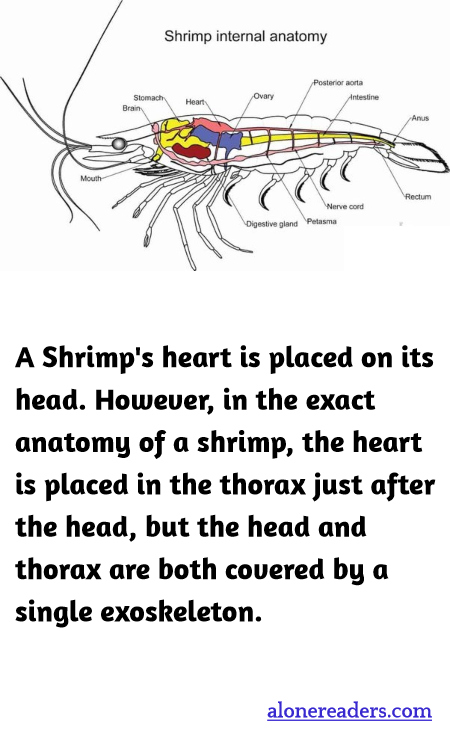
Shrimp, one of the most fascinating creatures living in aquatic environments, possess a unique anatomical feature that often leads to the myth that their hearts are located in their heads. While it appears that way at a glance due to the close proximity of body parts, the reality of shrimp anatomy is slightly more complex due to their distinctive structural makeup.
In shrimp, the body is primarily divided into two main parts: the cephalothorax (which is a fusion of the head and the thorax) and the abdomen. What often causes confusion is that both the head and the thorax are encased in a single, unsegmented shell called the carapace. This makes it seem as though all the primary organs are contained within the head.
The heart of a shrimp, in actuality, is located in the thorax, just behind the head. Enclosed by the carapace, the heart pumps blood throughout the body, functioning efficiently thanks to the shrimp’s open circulatory system. In this system, blood flows freely within the body cavity, reaching all tissues and organs, rather than being confined within vessels as seen in more advanced organisms.
The positioning of the heart so close to the head can be seen as an evolutionary adaptation that perhaps enables quicker response times and more efficient circulatory processes, vital for survival in diverse and often hostile aquatic environments. This central location of the heart helps in distributing nutrients and oxygen rapidly across its small body.
Thus, while shrimp do not literally have their hearts in their heads, their unique anatomical structure, combined with the protective feature of the carapace, showcases an intriguing aspect of crustacean biology that blurs the lines between what we typically understand as the separate regions of head and torso in vertebrate animals. This peculiarity not only highlights the diversity in nature's designs but also elucidates how different organisms adapt their body structures to suit their environments and lifestyles.
