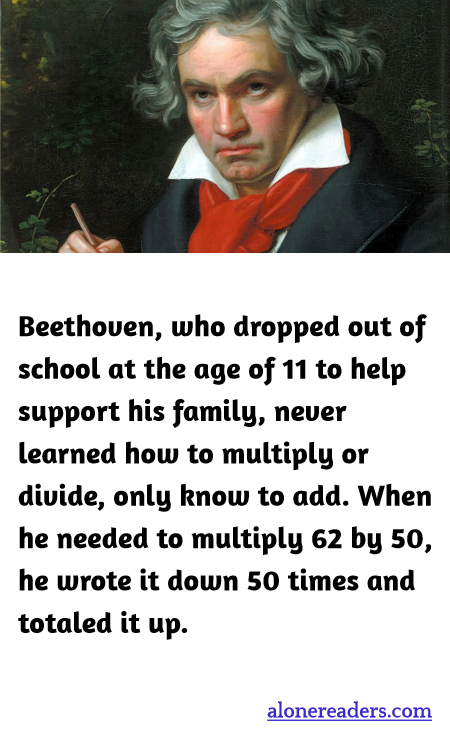
Ludwig van Beethoven, one of the most revered composers in the history of Western music, had a challenging early life that shaped his path to greatness in ways that deviate significantly from typical scholarly education. Born in 1770 in Bonn, Germany, Beethoven was thrust into the role of breadwinner for his family from a remarkably young age. His father, Johann van Beethoven, recognized Ludwig's musical talent early on and was determined to showcase him as a child prodigy, much like Mozart. This pressure led to Beethoven's withdrawal from formal schooling at the tender age of 11, to focus entirely on his musical training and performances.
In missing out on a formal education, Beethoven did not learn some basic arithmetic operations, such as multiplication and division—skills that are often taken for granted. His approach to solving complex multiplication problems was notably primitive yet fascinating. When faced with the need to multiply 62 by 50, Beethoven would painstakingly write out 62 up to 50 times and then sum all the figures to find the answer. This method, while crude and time-consuming, underscores a profound level of dedication and problem-solving that also permeated his approach to music.
Despite these limitations in his mathematical abilities, Beethoven's musical compositions were structurally complex and innovatively brilliant. His work pushed the boundaries of music theory and composition, embodying a deep emotional expression and structural rigor that scarcely seems hampered by his lack of formal education. This juxtaposition of personal educational gaps with professional excellence highlights a crucial narrative in Beethoven's life: the triumph of innate talent and relentless perseverance over traditional academic achievement.
Beethoven's legacy is not only a testament to his incomparable musical genius but also an inspirational story of overcoming personal and educational shortcomings. His life reminds us that education, while undoubtedly valuable, is not the sole determinant of personal success and contribution to society. Beethoven's music continues to resonate deeply with audiences around the world, serving as a lasting symbol of human creativity and resilience. Through his compositions, he communicated in a universal language that transcended the limitations he faced, a language in which he was fluently articulate: the language of music.
