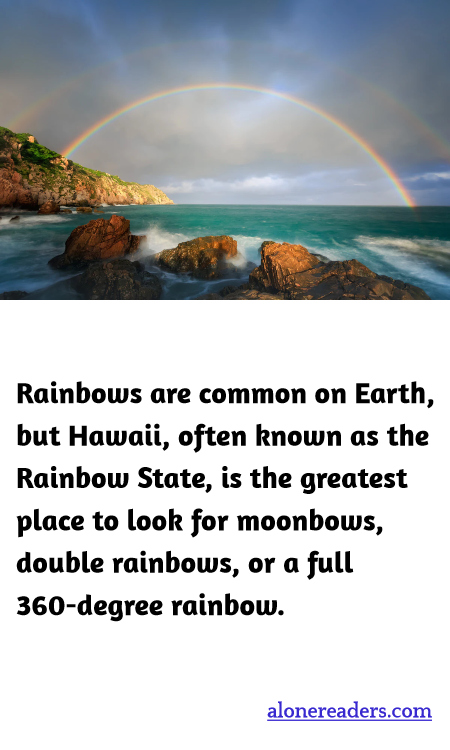
Rainbows, a captivating natural phenomenon, manifest as multicolored arcs in the sky due to the refraction, dispersion, and reflection of light in water droplets. While they grace skies worldwide, Hawaii, aptly nicknamed the Rainbow State, offers some of the most spectacular and unique rainbow views on Earth. Here, not only typical rainbows thrive, but moonbows, double rainbows, and even full 360-degree rainbows appear with greater frequency and clarity than perhaps anywhere else.
Hawaii's geographical and meteorological conditions set the perfect stage for rainbow sightings. The islands' position amidst the vast Pacific Ocean ensures ample moisture in the air. Frequent brief rain showers followed by sunshine provide the ideal scenario for rainbows. The mountainous terrain, which forces moist ocean air upwards, cools it and creates precipitation, further enhances these conditions. The frequent and rapid alternation between rain and sunshine means rainbows, often very vivid, appear regularly.
Moonbows, or lunar rainbows, which occur at night, are especially rare and ethereal. These form when moonlight, rather than sunlight, refracts through water droplets in the air. While similar to solar rainbows, moonbows often appear fainter and white to the human eye, though long-exposure photographs can reveal their true colors. Hawaii's clear, dark skies and frequent nighttime showers create the perfect environment for moonbows, making the islands an ideal spot for viewing this nocturnal spectacle.
Double rainbows occur when sunlight reflects twice within a water droplet, producing a secondary rainbow above the primary arc, displaying a spectrum reversed from the original. The conditions conducive to rainbow formation are so prevalent in Hawaii that double rainbows are a common, delightful sight, adding an extra layer of beauty to the already stunning landscapes.
Full 360-degree rainbows are a rarer sight and are typically observable from higher elevations where the observer can see beyond the usual horizon limit. In Hawaii, spots like the peaks of Mauna Kea or Haleakala on clear days after rainfall can provide the perfect viewpoint to witness these extraordinary circular rainbows encircling the observer.
Hawaii's unique ability to produce such a variety of rainbows is one of many natural treasures that make it a paradise not only for vacationers but also for enthusiasts and photographers captivated by the pursuit of these meteorological wonders._CAPTURE_CONTEXT:
Rainbows, a captivating natural phenomenon, manifest as multicolored arcs in the sky due to the refraction, dispersion, and reflection of light in water droplets. While they grace skies worldwide, Hawaii, aptly nicknamed the Rainbow State, offers some of the most spectacular and unique rainbow views on Earth. Here, not only typical rainbows thrive, but moonbows, double rainbows, and even full 360-degree rainbows appear with greater frequency and clarity than perhaps anywhere else.
Hawaii's geographical and meteorological conditions set the perfect stage for rainbow sightings. The islands' position amidst the vast Pacific Ocean ensures ample moisture in the air. Frequent brief rain showers followed by sunshine provide the ideal scenario for rainbows. The mountainous terrain, which forces moist ocean air upwards, cools it and creates precipitation, further enhances these conditions. The frequent and rapid alternation between rain and sunshine means rainbows, often very vivid, appear regularly.
Moonbows, or lunar rainbows, which occur at night, are especially rare and ethereal. These form when moonlight, rather than sunlight, refracts through water droplets in the air. While similar to solar rainbows, moonbows often appear fainter and white to the human eye, though long-exposure photographs can reveal their true colors. Hawaii's clear, dark skies and frequent nighttime showers create the perfect environment for moonbows, making the islands an ideal spot for viewing this nocturnal spectacle.
Double rainbows occur when sunlight reflects twice within a water droplet, producing a secondary rainbow above the primary arc, displaying a spectrum reversed from the original. The conditions conducive to rainbow formation are so prevalent in Hawaii that double rainbows are a common, delightful sight, adding an extra layer of beauty to the already stunning landscapes.
Full 360-degree rainbows are a rarer sight and are typically observable from higher elevations where the observer can see beyond the usual horizon limit. In Hawaii, spots like the peaks of Mauna Kea or Haleakala on clear days after rainfall can provide the perfect viewpoint to witness these extraordinary circular rainbows encircling the observer.
Hawaii's unique ability to produce such a variety of rainbows is one of many natural treasures that make it a paradise not only for vacationers but also for enthusiasts and photographers captivated by the pursuit of these meteorological wonders.
