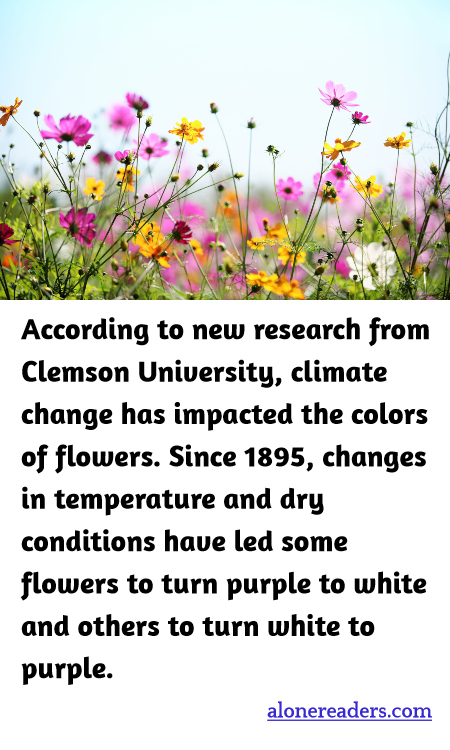
The unfolding impacts of climate change on our natural environment are continuously being discovered, and recent research from Clemson University has unveiled yet another intriguing consequence: the alteration of flower colors. This study highlights the intricate relationship between environmental changes and floral characteristics dating back to 1895. Researchers have observed a fascinating trend where certain flowers that were originally purple have transformed to white, while others have shifted from white to purple. These changes are believed to be responses to shifts in temperature and moisture availability.
Flower color is not merely a matter of aesthetic appeal; it plays a crucial role in the survival and reproduction of flowering plants. Colors in flowers are primarily influenced by pigments such as anthocyanins, which can create a spectrum ranging from red to blue. The coloration of flowers typically serves to attract pollinators like bees, birds, and insects. Therefore, any shift in color can influence the types of pollinators that visit the flower, potentially impacting pollination success.
The research indicates that as temperatures have risen and as certain regions have experienced drier conditions, these environmental stresses have likely driven the evolutionary change in flower colors. For instance, the reduction in anthocyanin pigments can lead to a color shift from purple to white. Conversely, in some cases, environmental changes might stress plants in ways that result in an increased concentration of these pigments, leading to the deepening of color from white to purple.
The findings from this study are significant as they suggest that climate change is not only a global health and economic issue but also deeply affects biodiversity and ecosystem services like pollination. Plants and pollinators are highly co-dependent, and changes in one can have cascading effects on the other and on the broader ecosystem. This alteration in flower color might adapt plants to new pollinators or changing environmental conditions, but it could also disrupt existing plant-pollinator relationships, potentially leading to reduced plant reproduction and altering community compositions.
As researchers continue to examine the long-term impacts of these color changes, it becomes clear that understanding and mitigating the effects of climate change on our natural world requires a detailed exploration of these subtle yet significant transformations. Such research not only deepens our understanding of how biodiversity adapts but also aids in conservation efforts, ensuring the preservation of ecosystems in a rapidly changing world.
