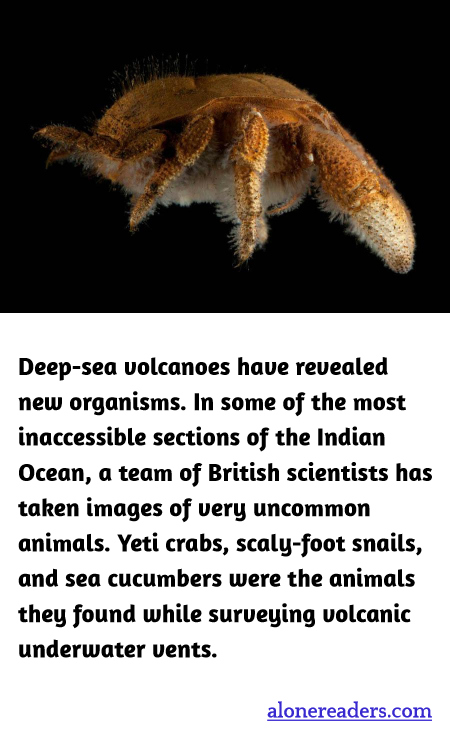
Deep-sea environments, particularly those around underwater volcanoes, continue to be some of the least understood and most intriguing on our planet. Recently, a team of British scientists exploring deep-sea volcanic vents in the Indian Ocean captured stunning images and evidence of unique organisms living in these extreme conditions. Among these are yeti crabs, scaly-foot snails, and various types of sea cucumbers, each adapted to survive in the harsh environments near hydrothermal vents.
Hydrothermal vents are essentially underwater geysers that expel mineral-rich water heated by volcanic activity beneath the sea floor. The temperatures in these environments can soar to over 700 degrees Fahrenheit, and yet they teem with life. This high thermal activity provides a special niche ecosystem where usual forms of life would not survive, and yet, it supports a diverse biological community entirely reliant on chemosynthesis. In chemosynthesis, bacteria and other microorganisms convert chemicals released by the vents into energy, forming the base of the food web.
The yeti crab, for example, is particularly fascinating because this species "farms" its own food. They have hairy patches on their claws that harbor bacteria, which they presumably cultivate by waving their "farms" in the mineral-rich water, although details of their diet and exact methods are still being researched. The scaly-foot snail stands out with its unique iron-coated shell, a marvelous evolutionary development likely evolved as a defense against predators in its metallic-rich deep-sea environment.
Studying these organisms offers critical insights into the limits of life on Earth and can possibly hint at how life might exist on other planetary bodies. For instance, the extreme conditions at these vents are analogous in some ways to suspected subsurface oceans on moons like Jupiter’s Europa or Saturn’s Enceladus. Learning how life thrives in Earth’s deep-sea vents can guide scientists in understanding where and how to look for life elsewhere in the solar system.
Moreover, these endeavors can lead to discoveries with direct benefits to humans such as new enzymes for medical and industrial applications, derived from organisms adapted to extreme environments. The isolation and uniqueness of vent ecosystems also mean that they can be vulnerable to disturbance from deep-sea mining and other human activities. Thus, understanding these systems not only satiates human curiosity but provides the knowledge necessary to manage and protect these incredible environments responsibly.
