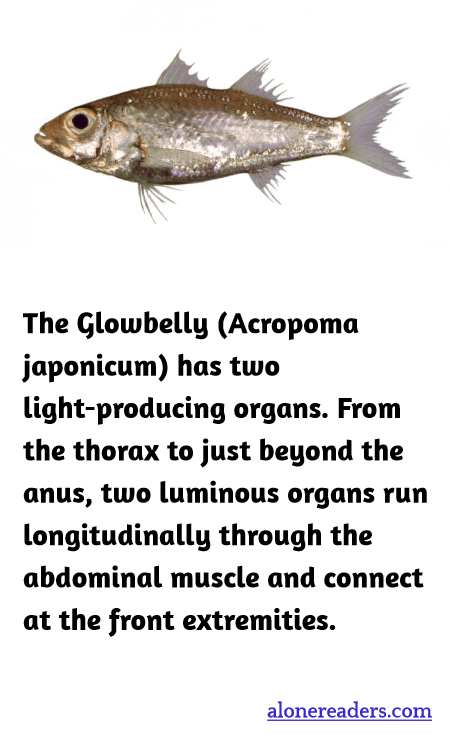
The Glowbelly, scientifically known as Acropoma japonicum, is truly one of the marine world's most fascinating creatures, largely due to its unique ability to produce light. Primarily found in the ocean's depths around Japan and other parts of Southeast Asia, this fish has adapted remarkably to the dark underwater environment.
One of the most striking features of the Glowbelly is the presence of two specialized light-producing organs. These organs stretch in a longitudinal fashion from the thorax to slightly beyond the anus. This configuration is not just a random scattering of light-producing cells but a well-organized structure embedded within the abdominal muscles of the fish.
The bioluminescent feature of the Glowbelly functions primarily as a mechanism for both predator avoidance and communication. In the deep sea, where light is minimal or non-existent, bioluminescence serves as an essential mode of interaction. The light produced can be used to attract mates or to deter predators by either startling them or by making the fish appear larger than it actually is.
The light-producing organs of the Glowbelly are connected at the front extremities, suggesting a sophisticated system of light control. This anatomical arrangement allows the fish to alter the intensity and perhaps even the color of the light based on different stimuli or needs. The ability to manipulate light in such a way could be critical during mating seasons or when navigating through the densely populated or predator-laden waters.
The study of creatures like the Glowbelly contributes significantly to our understanding of life in the deep sea. It also holds potential advancements in technology, particularly in areas like bio-inspired lighting and optical communication systems. As researchers continue to uncover the secrets of bioluminescence, the Glowbelly remains a glowing example of nature's ingenuity deep beneath the ocean's surface.
