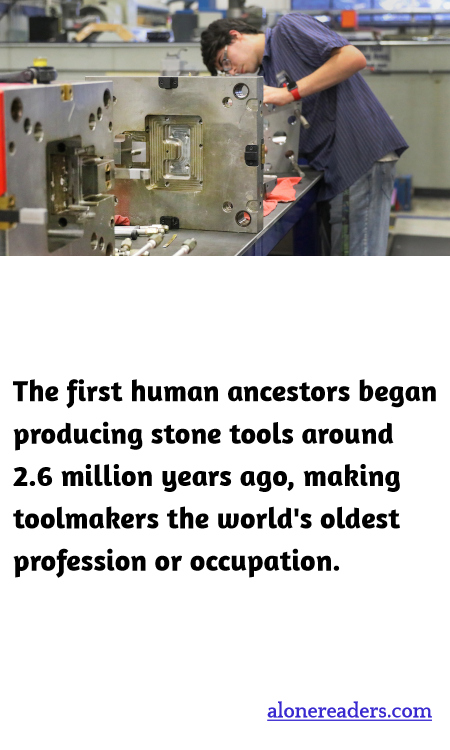
The creation of stone tools by our human ancestors marks a significant milestone in the development of human societies and technologies. Around 2.6 million years ago, a time in prehistory classified as the Paleolithic period, early humans began to fashion simple tools from stone, an activity that can be considered the world's oldest profession or occupation.
These early humans, known as hominins, specifically the species Homo habilis, were the first known to create stone tools. This craft is often referred to as the Oldowan tradition, named after the Olduvai Gorge in Tanzania where these artifacts were first discovered. The use of stone tools was a major evolutionary advance that provided these early human ancestors with a means to more effectively interact with their environment, to cut, scrape, pound, and dig. This new capability potentially led to a more varied diet, as tools could be used to process meat and plants more efficiently than bare hands or natural occurrences could.
The skills involved in making and using stone tools contributed significantly to the cognitive and motor skills development, which are hallmarks of human evolutionary progress. These tools played a crucial role in the survival and adaptation of early humans, enabling them to accomplish tasks that would have been impossible with bare hands alone, such as processing tough animal hides or breaking open bones to access marrow.
The tradition of tool-making did not remain static but evolved over hundreds of thousands of years. It grew more sophisticated with each passing millennium. Eventually, it led to the development of more advanced technologies such as the Acheulean hand axes, which exhibited a greater level of symmetry and required a more complex understanding of material properties. This evolution of tool-making techniques illustrates the gradual growth in cognitive abilities and cultural complexity within early human communities.
Considering the profound impact that these early stone tools had on the course of human evolution and survival, it is clear that the manufacture and use of these tools was not merely an occupation - it was a fundamental aspect of life that shaped the anatomical and cultural evolution of our species. Thus, the creation of stone tools is rightly considered the world's oldest profession, central to the narrative of human ingenuity and adaptation.
