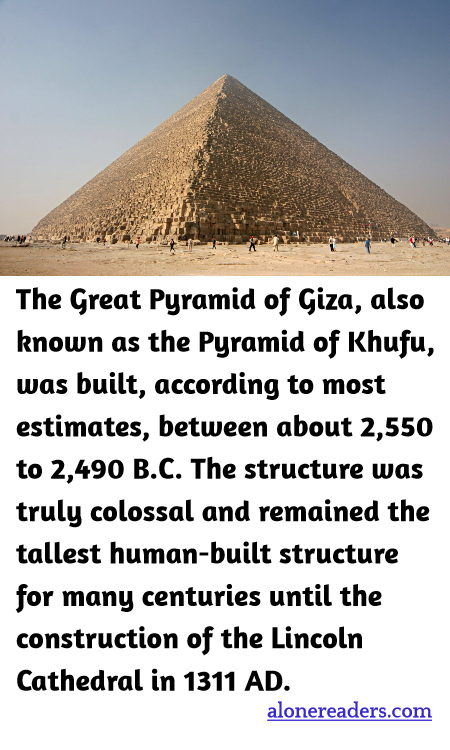
The Great Pyramid of Giza, also known as the Pyramid of Khufu, stands as an architectural marvel and a testament to the ancient Egyptians' ingenuity and understanding of engineering and mathematics. Constructed between approximately 2550 to 2490 B.C., this colossal structure not only served as a tomb for Pharaoh Khufu but also as a demonstration of power and religious dedication, aimed at securing the pharaoh's journey into the afterlife.
The Great Pyramid was originally built to a height of 146.5 meters (481 feet), making it the tallest man-made structure in the world for over 3,800 years, until it was surpassed by the Lincoln Cathedral in 1311 AD. Remarkably, the precision involved in its construction is evident from its alignment to the cardinal points and the uniformity of the limestone blocks. Approximately 2.3 million blocks, each weighing an average of 2.5 to 15 tons, were cut, transported, and assembled to create this ancient wonder.
One of the most fascinating aspects of the Great Pyramid is its complex inner chambers, which are not merely confined to the lower portion but also extend upwards into the massive structure, featuring the Grand Gallery and the King's Chamber. The purpose and the method of construction of these chambers continue to be subjects of rigorous academic research and debate.
Modern studies highlight the extraordinary organization and logistics required for such a construction project, involving tens of thousands of workers, including skilled laborers, engineers, and administrative oversight, possibly working in shifts to complete this ambitious project over a twenty-year period. The building of the Great Pyramid at a time when modern technologies did not exist underscores the Egyptians' advanced knowledge of geometry and their capability to organize vast resources over decades.
The Pyramid of Khufu not only dominates the plateau of Giza but also continues to fascinate architects, historians, archeologists, and tourists alike. As part of the Giza pyramid complex, it is designated as a UNESCO World Heritage site, drawing millions of visitors who aspire to see its grandeur and perplexing mysteries in person. This monumental structure not only reflects the administrative and technical prowess of ancient Egypt but also its enduring allure in human history.
