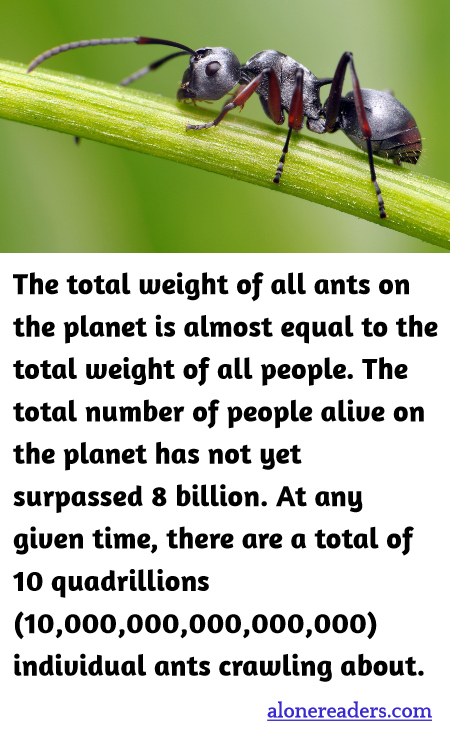
Ants are among the most successful species on Earth, both in terms of their ubiquity and sheer biomass. It's fascinating to consider that the combined weight of all these tiny creatures is roughly equivalent to the total weight of the human population. Despite their small size, the sheer number of ants is staggering. With communities spread around the globe, the total number of ants is estimated to be around 10 quadrillion. This impressive figure illuminates the immense scale of their collective presence compared to our own species, which hasn't yet reached 8 billion individuals.
This comparison not only highlights the success of ants as a species but also offers a perspective on biodiversity and the distribution of life on Earth. Ants, with their complex social structures and ability to adapt to diverse environments, play crucial roles in ecosystems. They aerate the soil, help with the decomposition of organic material, and some species are predators that help control other pest populations.
Thus, the seemingly simple comparison between the mass of ants and humans underscores significant ecological truths. It reminds us of our place within the biosphere and the intricate balance of life. Ants, through their sheer numbers and biomass, reveal the incredible interconnectedness of life forms and the importance of every species, no matter how small, in maintaining the health of our planet.
