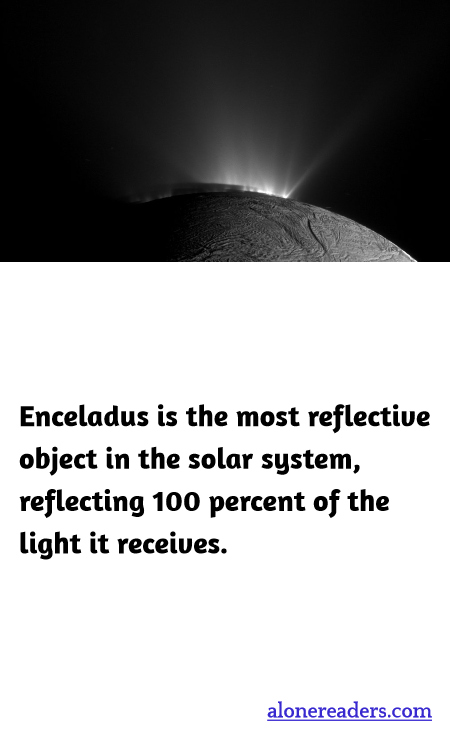
Enceladus, one of the many moons orbiting Saturn, holds a unique record in our solar system—it is the most reflective body known, bouncing back all the sunlight that hits its icy surface. This extraordinary reflectivity gives Enceladus an almost mirror-like appearance, making it a fascinating subject of scientific study. This high level of reflectance is primarily due to the moon's surface composition, which is largely covered by fresh, clean ice.
The icy surface of Enceladus is constantly replenished by a series of geysers located at its south pole. These geysers spew out water vapor and ice particles from an ocean of liquid water believed to be beneath the moon’s surface, hidden under the ice crust. This process not only keeps the surface ice fresh but also contributes to one of Saturn’s rings—the E Ring—by feeding it with ice particles from the geysers.
NASA's Cassini spacecraft, which explored Saturn and its moons from 2004 to 2017, conducted multiple flybys of Enceladus, revealing its icy jets and the intriguing chemistry of its subsurface ocean, which includes organic compounds, salts, and silica. The presence of these materials suggests a hydrothermal activity at the ocean floor, which could potentially create conditions similar to those that gave rise to life on Earth. This makes Enceladus a prime candidate in the search for extraterrestrial life within our solar system.
The scientific interest in Enceladus has grown significantly as a result of these findings, leading to discussions about future missions that could probe deeper into the secrets held by this icy moon. Scientists hope to gather more detailed data on the ocean’s composition and the geological activity that maintains its frozen surface so reflective. By understanding more about Enceladus, researchers aim to gain insights not only into the moon’s potential habitability but also into the broader processes that shape icy bodies in the outer solar system and beyond.
