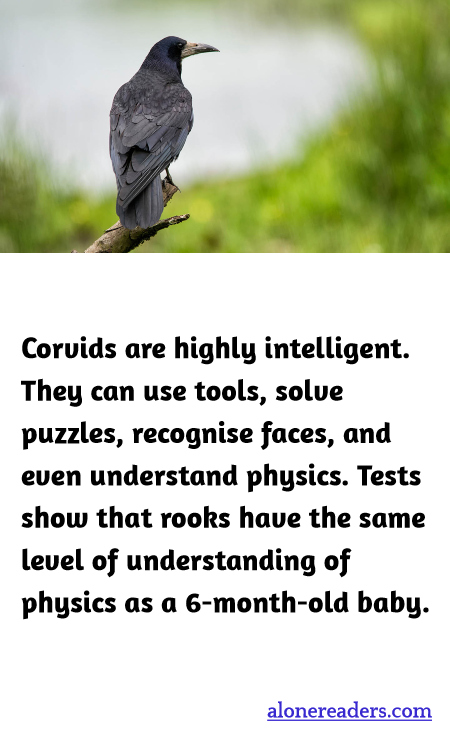
Corvids, a family that includes crows, ravens, magpies, and jays, are among the most intelligent birds in the world. Their cognitive abilities are so advanced that they can use tools, solve complex puzzles, recognize human faces, and even grasp basic concepts of physics. These skills make corvids fascinating subjects of scientific studies focusing on animal intelligence.
In terms of tool use, certain species like the New Caledonian crow are particularly adept. These crows can create and utilize tools from materials available in their environment to extract insects or other food from tight spaces. This behavior is not only a demonstration of their problem-solving skills but also their ability to plan ahead and store tools for future use, a trait once believed to be uniquely human.
Corvids have also demonstrated their ability to solve puzzles. In experiments, they can navigate a series of challenges for rewards, indicating a high level of problem-solving ability and understanding of cause-and-effect relationships. These tests often involve multiple steps and require the birds to utilize both their memory and reasoning skills.
Recognizing faces is another area where corvids excel. Studies have shown that crows, in particular, can remember individual human faces for several years. They can distinguish between threatening and non-threatening humans and even communicate this information to other crows. This indicates not just memory, but complex emotional and communicative capacities.
Their understanding of basic physics was highlighted in a study comparing young rooks with human infants. The rooks demonstrated an understanding of concepts like the effects of dropping different objects that rival the understanding of a 6-month-old baby. This includes understanding that objects need support to prevent falling and that heavier objects can cause more significant impacts when dropped.
Overall, corvids challenge our understanding of the intellectual abilities of non-human animals. Their cognitive feats suggest a level of intelligence that in many ways parallels that of great apes and marine mammals. This similarity raises important questions about the evolution of intelligence and the other possible forms intelligence can take beyond what is observed in humans. These insights not only deepen our understanding of animal cognition but also encourage a greater appreciation and respect for the intelligence that exists in the avian world.
